I was at the annual Women’s Retreat last weekend and we started telling stories. There’s always a certain combination of personalities that, when you get them together, provides the kind of therapeutic laughter that makes the stress just pour out of you. This was our tenth retreat and we think we’ve got the technique down pretty good. We offer massages, nature hikes, canoeing, dynamic worship and a great speaker. But the best part of the whole weekend is totally out of the planning team’s hands; and that’s the people who come and provide the laughter. Anytime I get a chance to be in the same room with Phyllis Hock I take it because there is guaranteed laughter. Women like Phyllis may not fully appreciate what a ministry they have in their ability to make us all find the fun in life. But it wasn’t Phyllis this time, it was Linda Peavy. We started telling stories of times we almost got kicked out of church. And this was as adults, mind you, not when we were children.
Linda and I raised our kids together. I babysat her two boys every afternoon for a while until I went back to work. In fact, her youngest son was in my daughter’s class in the first grade and was madly in love with her until she had her hair cut. After that, he moved on to the next little girl with long black hair, eventually marrying a woman with long black hair. We had a group of friends from church who would periodically get together for a glass or two of wine. We’d all bring our kids and let them play with each other while we relaxed and enjoyed the peace and quiet. I threw a party every Christmas Eve and we’d have some snacks and liquor for a couple of hours then all go to church for the midnight service. We were just a big extended family who not only laughed and drank together but worshipped God together. And now we were retreating together and sharing stories of our grandchildren along with stories of when we were younger.
Linda started out telling the story of the Sunday her son farted during the prayers of the people. Most of the people I was praying for wouldn’t have cared if the kid farted but we had one of those stern Calvinist ministers back then and he was the kind who would, and did, correct kids right in the middle of worship. I don’t know for a fact, mostly because I didn’t pay a lot of attention, but I’m pretty sure he believed firmly in the totally depravity of mankind. And Linda and I were prime examples.
It really wasn’t the farting that set us off, it was Chris' astonished expression. It wasn’t one of those smelly ones, just a little “toot.” And it wasn’t even that loud but Chris was so startled by it Linda commenced to laugh right there in the longest prayer of the service, the one time the entire sanctuary was absolutely silent. To her credit, Linda didn’t make a sound but when I saw her whole body shaking, I lost it. When I started, my whole family went off and pretty soon the whole pew, not just the people, the pew furniture, was shaking. To make matters worse, we were right in the middle and on the front row, right under the preacher’s nose and we knew it. Then our friend Kit, sitting behind us, saw what was happening, though I’m not sure how, because this was the prayers of the people and we’re all supposed to have our eyes shut and communing with the Lord and all. Maybe Kit’s mother forgot to teach her to close her eyes during the prayers of the people. When she and her son saw us shaking the pew, they commenced to laugh, too. Fortunately for all of our souls the laughter was limited to just those two pews or we would have all gone to hell for sure.
Linda got me into a lot of trouble in those days when we were trying to mature into the dignified and solemn matrons we are today. The next thing I knew it was Christmas Eve and the same group of us were all sitting in the cry room at the back of the church gasping for air between gales of laughter. Our Christmas Eve party had become a tradition by this time. We may have had a little too much fellowship that year because we got to church late. But that may have been our saving grace. The church had a glass enclosed, sound-proof, “cry room” at the very back of the sanctuary. Because we were late we just all staggered into the cry room and plopped ourselves down.
That year the choir had chosen to wear casual clothes instead of their regular choir robes. One of the most pompous and conservative old guys in the church sat there in his regular spot in the back of the choir wearing a beige turtleneck sweater. I’m sure he thought it was a festive touch but it made him look stark naked. Naked as a jaybird. Birthday suit naked. Wrinkled old man at a nudist colony naked.
The instant our group saw him we burst out laughing and laughed and laughed and laughed. We laughed right through the lighting of the Christ candle. We laughed through Martin Luther’s classic sermon and the ringing of the bell and all of it. We didn’t stop until church was over and we staggered back out into the Christmas night. If there was any question of the total depravity of mankind, we removed the doubt that year.
But I have to say that the hardest I have ever laughed in my life was at the viewing when Emma Grantham died. I can’t blame Linda for that one; it was Kit who was my bad influence that night.
In our defense, it was late and it had been a busy day for both of us and you know how giggly you get when you’re tired. Emma was old and ready to die. The viewing of the body was one of those social obligations that our mothers taught us to do. You go sign the book so the family will know somebody cared about dear old Emma. You peep in at the dearly departed, say goodbye to them and go home.
But this time when we walked into Williams Funeral Home there was a huge crowd of people in the building and we were carried along in the traffic of mourners. I thought to myself at the time that I didn’t know Emma had so many friends. As we walked along, Kit leaned over to me and whispered out of the corner of her mouth, “Jane, I don’t know any of these people.” We finally wove our way though the crowd and got up to the casket and looked in. After a minute of standing there looking into the casket, I quietly announced what we both knew, “Kit, we don’t know the deceased.”
With that, we lost it. We both burst out laughing. But we knew how bad it would look so we quickly covered our faces and tried to pretend we were overcome with grief. All we could think of was how to get out of the building as fast as we could. But because of the crowd, it seemed like we were going in slow motion. Gales of laughter came bubbling up as we desperately fought through the crowd. We stopped at the first Kleenex station we found and got handfuls of Kleenex to cover our faces. Somehow we went through a wrong door and ended up in the kitchen which only made us laugh harder but we took the opportunity to pick up a few paper towels to reinforce our Kleenex. After a while I was laughing so hard I had tears rolling down my face so I decided I could use this to my advantage and moved the Kleenex from my eyes, still covering my mouth, as if to say “see, I’m not laughing, I’m really crying.”
When we finally got outside we sat on the curb right there at Main and Glenbrook and just Who-Hawed. I've never laughed so loud and so hard in my life. Then who should we see but our friend, Linda, looking solemn, serene and dignified as she waited to go see the real Emma. It was Linda’s golden moment of being the perfect adult as she looked down on us there in the gutter holding our wads of Kleenex and dissolved in our wet spasms.
I think that was the last time Kit and I went to a viewing together. Come to think of it, we don’t sit by each other in church anymore, either. It’s just better that way. God knows.
About Me

- Jane
- I'm pretty much a typist for the Holy Spirit. I try to put those things into words in a blog called Jane's Journey. I have another blog for recipes called My Life in Food. Also Really Cool Stuff features Labyrinths and other things like how to fry an egg on the sidewalk.(first step: don't do it on the sidewalk, use a skillet) Come along with me as I careen through life.
Wednesday, February 28, 2007


Wednesday, February 21, 2007
Valentines Day Report
My friend Ann sent around an email last week, really more of a prayer:
February 13th: Dear Lord, give me strength and "sisters" give me sympathy--for a husband who says, "I talked to the folks at Super S Grocery about what I should consider giving you for Valentine's Day."
I figure she was dreading that she might end up with maybe a smoked ham or kitchen cleansers or something. I couldn’t offer much advice since I knew I was receiving a 12-volt DeWalt cordless drill. But, in Beaven’s defense, that’s exactly what I asked for. This was a far cry from the year of “the incident.”
“The incident,” as we refer to it in family lore happened one year when I was working at First National Bank in downtown Garland. Banks are normally habituated primarily by women employees, most of who are either sleep-deprived or suffer from a lack of estrogen. It just seems like most bank employees fall into one of two or three categories. They are either new mothers with babies who keep them awake all night or mothers who get “the call” every afternoon after school and have to referee fights between siblings over the telephone. Being a mother isn’t the easiest job you get. It always made balancing a couple of million dollars in the vault to each teller's drawer seem easy. So, when Valentines Day rolls around, you figure you will finally receive some sort of reward, some token of love. Lord knows you deserve it.
The year in question, I was in the “afternoon phone call” stage of motherhood when the girls would dutifully call each afternoon to tell me that they were home from school. Then they would usually either announce that there was no food in the house or that their mentally ill sister had just committed some unpardonable sin. The “day in question” may have also been the day that the latest unpardonable sin was a younger sister riding around the street on her bicycle with her older sister’s flute dragging behind on the pavement. Or something similar.
I was in need of flowers. That Valentines Day I watched the parade of floral deliveries all day long waiting for mine even though I knew Beaven was far too practical and/or brain damaged to get me flowers. His preferred method of showing love was to change the oil in my car.
I got home that night and started our annual Valentines Day argument. I won’t go into gory details here but the evening ended with the statement, “If you would just send the damned flowers I would shut up.”
A week or so later the flowers arrived. Enough time had gone by that most of the women at work had forgotten all about Valentines Day. They twittered with questions about what I had done to deserve this out-of -season gesture. When they asked me what the flowers were for I had to glumly admit they were for “being a bitch.”
And, per my agreement, I have had to shut about flowers. It was the last delivery of flowers I ever got. In the years since I’ve learned to appreciate it whenever he changes the oil in my car. That may be the closest I ever get to flowers again.
Well, yes, there was the Vespa last year. I guess that took care of all the Valentines past, present and future. I don’t kid myself that it was purely a starry-eyed romantic gift, though. He probably didn’t even realize it was Valentines Day until the lady in the store gave him red balloons to bring home. But it was enough to score major points in the gift department. It sure beats a canned ham.

February 13th: Dear Lord, give me strength and "sisters" give me sympathy--for a husband who says, "I talked to the folks at Super S Grocery about what I should consider giving you for Valentine's Day."
I figure she was dreading that she might end up with maybe a smoked ham or kitchen cleansers or something. I couldn’t offer much advice since I knew I was receiving a 12-volt DeWalt cordless drill. But, in Beaven’s defense, that’s exactly what I asked for. This was a far cry from the year of “the incident.”
“The incident,” as we refer to it in family lore happened one year when I was working at First National Bank in downtown Garland. Banks are normally habituated primarily by women employees, most of who are either sleep-deprived or suffer from a lack of estrogen. It just seems like most bank employees fall into one of two or three categories. They are either new mothers with babies who keep them awake all night or mothers who get “the call” every afternoon after school and have to referee fights between siblings over the telephone. Being a mother isn’t the easiest job you get. It always made balancing a couple of million dollars in the vault to each teller's drawer seem easy. So, when Valentines Day rolls around, you figure you will finally receive some sort of reward, some token of love. Lord knows you deserve it.
The year in question, I was in the “afternoon phone call” stage of motherhood when the girls would dutifully call each afternoon to tell me that they were home from school. Then they would usually either announce that there was no food in the house or that their mentally ill sister had just committed some unpardonable sin. The “day in question” may have also been the day that the latest unpardonable sin was a younger sister riding around the street on her bicycle with her older sister’s flute dragging behind on the pavement. Or something similar.
I was in need of flowers. That Valentines Day I watched the parade of floral deliveries all day long waiting for mine even though I knew Beaven was far too practical and/or brain damaged to get me flowers. His preferred method of showing love was to change the oil in my car.
I got home that night and started our annual Valentines Day argument. I won’t go into gory details here but the evening ended with the statement, “If you would just send the damned flowers I would shut up.”
A week or so later the flowers arrived. Enough time had gone by that most of the women at work had forgotten all about Valentines Day. They twittered with questions about what I had done to deserve this out-of -season gesture. When they asked me what the flowers were for I had to glumly admit they were for “being a bitch.”
And, per my agreement, I have had to shut about flowers. It was the last delivery of flowers I ever got. In the years since I’ve learned to appreciate it whenever he changes the oil in my car. That may be the closest I ever get to flowers again.
Well, yes, there was the Vespa last year. I guess that took care of all the Valentines past, present and future. I don’t kid myself that it was purely a starry-eyed romantic gift, though. He probably didn’t even realize it was Valentines Day until the lady in the store gave him red balloons to bring home. But it was enough to score major points in the gift department. It sure beats a canned ham.
Tuesday, February 13, 2007
Something Like Heaven
Something special is happening here in Pearlington, Mississippi. I’m not sure I can put my finger on it. I was looking around the room during lunch at the Missionary Baptist Church one day and said to the lady sitting beside me, “I wonder if this is what heaven is going to look like.” She took a while to look around and absorb the many shapes and colors of the faces around us as well as the many different conditions of the clothing they wore and the sounds of their voices, then she softly answered back, “Maybe we’re there now.”
If you get there right at 11:30 you are in time to have Rev Rawls bless the food and welcome everyone. He usually asks for a representative of each group to stand and say what state they are from. I figure he uses this to help us connect with each other and show how many people from so many different places are coming to help. By the time Rev Rawls had welcomed you, you felt seriously welcomed. I seldom saw him without a smile. He has a booming voice and would tell you right off the bat that he wanted you to come visit them that Sunday and to be there at 9:30 in the morning.

This is my third trip to Pearlington and I notice more and more people are on their second and third trip, also. And there’s something else that’s not only startling but true. Some people have basically moved here to help with the recovery. Yes, packed up clothes and came to Pearlington for an undetermined time. Some are retirees or folks who don’t need to work because there’s no paying work here, to speak of. Most of them eventually find a used FEMA trailer to stay in but there are several work camps they can stay at for a short period.
It was the surprises on this trip that impressed me the most. The people who came to help that you never thought of: the electrician from Las Vegas, the couple from Tennessee, the Canadians, the Mennonites. Is that what heaven will be like? Surprises? If heaven is anything like eating lunch at the church, I can’t wait to get there.

Lunch was served every weekday at the Missionary Baptist Church. It’s been this way almost a year now, ever since they replaced their damaged building with a fellowship hall that will eventually be joined to a new sanctuary. This is where any volunteer working in Pearlington is invited for a free lunch. It is Southern cooking at it’s absolute best. The ladies of this mostly black congregation spend all morning at the church cooking a huge variety of food. Other ladies bring dishes they’ve cooked at home. Some of the food is donated and some paid for through cash donations. We had cornbread every day. Catfish every Friday and when they cook on special Saturdays, it’s the best fried chicken I’ve ever had. Most days they have slaw, red beans and rice and greens. There is always a dessert; a cobbler perhaps or bread pudding.
At one end of the room sits a couple of stoves and a long table where the food is set out. There is a door to enter and another to exit. Traffic control is vital because the room is always packed. The first people to eat usually hurry to finish and free up a chair for the people standing in line. This is a no-nonsense crowd. There are no egos here and most people are tired when they break to eat. But there is a sense of honesty; that what you see is what you get, and the only room for pride is in a job well done. There was no fashion display. Most of us wore old clothes, sometimes ones that we would throw away as soon as we got home, knowing when we packed that the paint and joint compound would never be washed away.
When you enter the building the first thing in line is the hand sanitizer. While this might kill germs, it doesn’t do much for any paint or joint compound on your hands. But by putting on a whole gob of the stuff and rubbing for the few minutes it takes for the line to get to the food, you can end up with fairly clean hands. Along the left hand wall are boxes of canned food stacked waist high with napkins and boxes of plastic eating utensils. After you go through the food and dessert lines there’s a refrigerator with sodas and water. Then you sit at one of the six or seven long tables to eat.
If you get there right at 11:30 you are in time to have Rev Rawls bless the food and welcome everyone. He usually asks for a representative of each group to stand and say what state they are from. I figure he uses this to help us connect with each other and show how many people from so many different places are coming to help. By the time Rev Rawls had welcomed you, you felt seriously welcomed. I seldom saw him without a smile. He has a booming voice and would tell you right off the bat that he wanted you to come visit them that Sunday and to be there at 9:30 in the morning.

This is my third trip to Pearlington and I notice more and more people are on their second and third trip, also. And there’s something else that’s not only startling but true. Some people have basically moved here to help with the recovery. Yes, packed up clothes and came to Pearlington for an undetermined time. Some are retirees or folks who don’t need to work because there’s no paying work here, to speak of. Most of them eventually find a used FEMA trailer to stay in but there are several work camps they can stay at for a short period.
On most days there is such an assortment of people at lunch that it’s understandable if I confuse it with heaven. There might be a clump of Hispanics men in one corner, I think they are usually roofers; then there is always a group of elderly black men sitting with Rev. Rawls, who is the clear host of the meal. At the serving end of the room there are a variety of black women hovering over the stove and serving line. The rest of the room was filled with white faces: some wearing blue PDA shirts, some in the Methodist yellow shirts, some in the red shirts the Salvation Army wore. There were other individuals in worn paint-spattered clothes and scuffed work boots and tool belts worn so thoroughly that they were limp. Then in the middle of the room sat a group of Mennonites. They were easy to spot because the women all wore long calico skirts with their clean long hair gathered up on top their heads and covered with distinctive white caps. I never saw a hair out of place on any of these women. As the pastor of the Southern Baptist Church said at their building dedication, “They may look a little funny but they sure do good work.” It was common knowledge around town that the Mennonites didn’t have any experience in electricity or plumbing but no one could surpass them on carpentry.

photos by Judy Hain, February, 2007

I met Dorie and Luther, from Murfreesboro, Tennessee who are both retired and do mission work full-time. They go to the Mexico border part of the year, then return home to catch up on their mail, wash clothes and head back out to Mississippi. I think Dorie said their five weeks here has been the shortest time they've spent here. Luther is one of those guys who can do just about anything. We met him at Miss Mary’s house. He was laying ceramic tile while we painted. He and Dorie work as a team and she knows exactly what Luther will need as he prepares the floor for the tile.
What you couldn’t see as you look around the room at lunch because they look like everyone else is how many Canadians are here. Yes, Canadians. I think that has been my biggest surprise. This is an American problem yet the Canadians came to help. Some are staff at the PDA camp. Graham is a young adult volunteer from Ontario. Brian and Wilf and Mary and Charles are all from Canada. Kyra brought her daughter for the week because she didn’t have classes that week back in Canada. Kyra is on the staff with the Presbyterian church as a trauma counselor. Some aren’t getting paid to be here- maybe none of them, I never knew. They just came. I was sitting and talking with a group of people back at camp one day and realized I was the only American at the table; everyone else was Canadian. And they are such nice people I couldn’t help but think this is what Americans used to be like before we started being afraid of terrorists and global warming and world financial crises. They were easy going and generous but humble people.
On Friday I was helping build the rails around a two-story deck for a lady and she invited me to the special service they would have at the First Southern Baptist Church that Sunday. Kristian D’Ambrino would be there to sing the song she wrote for the town when she was Miss Mississippi in 2005, “Pearlington’s Prayer.” I already had a copy of the song and was impressed enough to want to attend the service.
At the beginning of worship the minister told the congregation that he had invited Rev Rawls and the Missionary Baptist church to join them in the dedication of the new sanctuary. Sure enough, about ten minutes into the service the doors opened and a crowd of about 20 or 30 people came in. After church was over I saw Shirley Thompson whose house we worked on in October. I remembered she goes to the AME church elsewhere in town but she had come for the dedication. This made for a solidly multi-racial crowd.
Sitting there watching so many people visiting for the dedication I thought a little about visiting. When you invite people to visit you have to be prepared to explain the way you do things and be ready to welcome them with open hearts and arms and make them feel welcomed. You are saying, “I will make room for you to sit where I usually sit. I will welcome your worship style and will give thanks to God for the wonderful differences between us.” This is what the white congregation said when they opened their doors with such love that day.
But I also learned a little about the compliment you pay when you become the guest and visit another church. I realized what a generous act that is. You are effectively saying, “I will worship the way you choose. I will sing your songs. Any money I put in the collection plate will be yours and I give up control of how you spend it. Your prayers will become my prayers. I will care about your concerns.” This is what the blacks of Pearlington were saying that day when they visited the all-white First Southern Baptist Church.
I couldn't help but notice how the races acknowledged each other with such love. Pearlington, I have been told, still has a KKK presence in the community, although I never saw any evidence of it. Certainly that hate group has a strong history in this tiny Mississippi town. At the end of the service the white minister looked over at Rev Rawls and said, “I’m glad these walls got knocked down so that across the racial lines we can gather and worship together.” As soon as he said this there were “Amens” from the black Missionary Baptist congregation and wild applause from the whites of the Southern Baptist church.
It was the surprises on this trip that impressed me the most. The people who came to help that you never thought of: the electrician from Las Vegas, the couple from Tennessee, the Canadians, the Mennonites. Is that what heaven will be like? Surprises? If heaven is anything like eating lunch at the church, I can’t wait to get there.
Wednesday, February 07, 2007
PDA Camp Life
OK, I only lasted two weeks. I probably could have stayed longer but they had a huge crowd coming in this week and with the camp still not moved I figured I would get out of the way.
But I got an answer to the two questions that were the main reasons for my trip. Yes, one person does make a difference. And I'm not so sure anymore about having the town back to normal by the second anniversary of the storm.
A big part of the rebuilding of Pearlington is the question of what normal means. Will it be when the buildings destroyed by the storm are rebuilt? Or will it be when the yards are greened up and cleaned up? Will it be when the stores and restaurants reopen? When everybody comes back?
To me, their new “normal” has so much potential that I’m willing to hold out for them to take their time for some other important things. In terms of race relations alone, this town has now become much more than it ever was and a big part of that process was working together after the storm. I don’t want to hurry that process.
During the two weeks I was in Mississippi the weather was cold and wet. If I thought I was going south for the winter I should have thought a little bit more. It wasn’t really freezing; it was usually in the mid-forties. But that’s a miserable enough temperature, don’t you think? One day it rained the whole time we were outside working. Also, you have to know that the camp is heated with kerosene stoves and kerosene is expensive, so they were pretty stingy with it. They don’t turn the heat on in the dining tent until dinner. And they don’t turn on the heat in the tents until around 8pm. So I was really limited on places I could go to be warm. I had brought my goose-down jacket with a hood so some afternoons I just wore that to lay in my unheated tent for a little nap before dinner.
On the job site there was seldom heat. Remember: this is what we’re here for—to rebuild houses that were washed away. If a house had heat it was probably ready to move into and there was no reason for me to be there. Our greatest luxury came when a house had a working toilet. Otherwise we had to scout the neighborhood for a porta-potty or just wait.
Since I was there for two weeks I got to watch two different teams come and go. The first team I worked with was from Iowa and the second was from Pennsylvania. It was interesting to be with total strangers. By the time I learned names of the Iowa crowd they left. With the Pennsylvania people I worked harder at getting to know them quickly and did a better job of it.
I also had the opportunity to help move the camp. The land Hancock county loaned to Presbyterian Disaster Assistance for their camp is the former site of the community center. The storm blew it away and PDA built a huge camp on the land. Huge means 30 tents on wooden platforms, three storage containers (the kind that eighteen-wheelers carry), a six unit shower tent, a kitchen building with adjoining pantry tent, a dining hall, an office building, two travel trailers for the camp managers and ten porta potties.
A couple of months ago the county got a grant to rebuild the community center and they had to start construction by February 1st or lose the grant. So they offered PDA the land next door where the post office was before the storm. (At the moment there isn’t a post office and people have to go to another town to send a package. During the move I stumbled on a pile of red bricks and realized that was all that was left of the post office.)
I got there in the middle of the move. Fortunately, the new site was only about a hundred yards from the old one and on the same side of the street. This was important. There was a huge issue with water. Here’s the problem, and it was a common one: the storm blew away all the landmarks.
After the storm hit if you remembered that your well and the water pump were next to the old live oak tree behind the house but the hurricane blew away not only your whole house but the tree as well, then it was kind of hard to find the well. And that was the case when they went to hook up the new camp to the old well at the post office. It wasn’t so much the storm blew stuff away as it was the bull dozers that came two weeks later and scooped up all the rubble. The only thing left of the post office was the foundation and the concrete parking lot. When they scooped up what was left of the post office they got the well pump as well. Without the pump or anything else above ground nobody could tell where the well was. And when I say “nobody” that includes not only the post mistress but the county supervisor and all fifteen or so guys who ever mowed the grass at the post office, the ones who had to trim around the well pump every week. And it seemed like every able bodied man in Hancock county had mowed the post office over the years because we had a parade of men come by to help locate the well. They came by and stood around to stare at the ground and scratch their heads. They called in a back hoe which dug deep trenches in every direction. No one ever found the pipes or the well. So, when I left they had made arrangements to dig a new well.
When we couldn’t get water at the new site the water gurus just ran a pipe from the old camp. We never could have done that if the new camp was anywhere else than just right next door. The only drawback was that there was deep drainage ditch between the two camps and anytime you went from one to the other you had to balance on a four by four thrown across the ditch to make an extremely skinny bridge.
After the Iowa team left on Friday we were mostly moved out of the old camp. They moved all ten of the potties except for one. You might say that I would have had my own private bathroom that weekend.

But I got an answer to the two questions that were the main reasons for my trip. Yes, one person does make a difference. And I'm not so sure anymore about having the town back to normal by the second anniversary of the storm.
A big part of the rebuilding of Pearlington is the question of what normal means. Will it be when the buildings destroyed by the storm are rebuilt? Or will it be when the yards are greened up and cleaned up? Will it be when the stores and restaurants reopen? When everybody comes back?
To me, their new “normal” has so much potential that I’m willing to hold out for them to take their time for some other important things. In terms of race relations alone, this town has now become much more than it ever was and a big part of that process was working together after the storm. I don’t want to hurry that process.
During the two weeks I was in Mississippi the weather was cold and wet. If I thought I was going south for the winter I should have thought a little bit more. It wasn’t really freezing; it was usually in the mid-forties. But that’s a miserable enough temperature, don’t you think? One day it rained the whole time we were outside working. Also, you have to know that the camp is heated with kerosene stoves and kerosene is expensive, so they were pretty stingy with it. They don’t turn the heat on in the dining tent until dinner. And they don’t turn on the heat in the tents until around 8pm. So I was really limited on places I could go to be warm. I had brought my goose-down jacket with a hood so some afternoons I just wore that to lay in my unheated tent for a little nap before dinner.
On the job site there was seldom heat. Remember: this is what we’re here for—to rebuild houses that were washed away. If a house had heat it was probably ready to move into and there was no reason for me to be there. Our greatest luxury came when a house had a working toilet. Otherwise we had to scout the neighborhood for a porta-potty or just wait.
Since I was there for two weeks I got to watch two different teams come and go. The first team I worked with was from Iowa and the second was from Pennsylvania. It was interesting to be with total strangers. By the time I learned names of the Iowa crowd they left. With the Pennsylvania people I worked harder at getting to know them quickly and did a better job of it.
I also had the opportunity to help move the camp. The land Hancock county loaned to Presbyterian Disaster Assistance for their camp is the former site of the community center. The storm blew it away and PDA built a huge camp on the land. Huge means 30 tents on wooden platforms, three storage containers (the kind that eighteen-wheelers carry), a six unit shower tent, a kitchen building with adjoining pantry tent, a dining hall, an office building, two travel trailers for the camp managers and ten porta potties.
A couple of months ago the county got a grant to rebuild the community center and they had to start construction by February 1st or lose the grant. So they offered PDA the land next door where the post office was before the storm. (At the moment there isn’t a post office and people have to go to another town to send a package. During the move I stumbled on a pile of red bricks and realized that was all that was left of the post office.)
I got there in the middle of the move. Fortunately, the new site was only about a hundred yards from the old one and on the same side of the street. This was important. There was a huge issue with water. Here’s the problem, and it was a common one: the storm blew away all the landmarks.
After the storm hit if you remembered that your well and the water pump were next to the old live oak tree behind the house but the hurricane blew away not only your whole house but the tree as well, then it was kind of hard to find the well. And that was the case when they went to hook up the new camp to the old well at the post office. It wasn’t so much the storm blew stuff away as it was the bull dozers that came two weeks later and scooped up all the rubble. The only thing left of the post office was the foundation and the concrete parking lot. When they scooped up what was left of the post office they got the well pump as well. Without the pump or anything else above ground nobody could tell where the well was. And when I say “nobody” that includes not only the post mistress but the county supervisor and all fifteen or so guys who ever mowed the grass at the post office, the ones who had to trim around the well pump every week. And it seemed like every able bodied man in Hancock county had mowed the post office over the years because we had a parade of men come by to help locate the well. They came by and stood around to stare at the ground and scratch their heads. They called in a back hoe which dug deep trenches in every direction. No one ever found the pipes or the well. So, when I left they had made arrangements to dig a new well.
When we couldn’t get water at the new site the water gurus just ran a pipe from the old camp. We never could have done that if the new camp was anywhere else than just right next door. The only drawback was that there was deep drainage ditch between the two camps and anytime you went from one to the other you had to balance on a four by four thrown across the ditch to make an extremely skinny bridge.
After the Iowa team left on Friday we were mostly moved out of the old camp. They moved all ten of the potties except for one. You might say that I would have had my own private bathroom that weekend.
The camp managers have travel trailers that had already been moved to the new camp. I knew they would have trouble justifying $35 worth of kerosene to heat one person so I bailed out and went to a hotel for Friday and Saturday nights.
In my two weeks there I spent two days dry-walling a house, two days mudding another house and two days painting a third one. I also spent a day helping build the rails on a deck. All of this was in addition to helping move the camp. Moving the camp involved a lot of plain old lifting something up and walking somewhere with it. But this wasn’t boxes; it was huge and heavy platforms of lumber, usually with something on top of it. We would get about twelve people around the sides and lift on the count of three. After moving the object the hardest part was letting go. You don’t ever want to be the last person holding onto something that heavy when the others decide to let go.
I got my own closet to drywall. I’m sure this is a huge no big deal to other people. But most of these projects turn into a bubba thing and women usually get relegated to carrying nails or something. This time none of the guys knew who I was or cared so they pretty much left me alone. I staked out a closet and did it all by myself. Well, yes, it did take me two days but that counts finding the right equipment and the right technique. Then there was the fact that the walls were over twelve feet high. Well, OK, maybe I didn’t do the whole closet. But if it had been eight foot walls I know I could have gone all the way to the ceiling by myself.
I’m not finished telling you about my trip but I have to stop for a while. In the next couple of weeks I want to tell you about the really important things I saw and did. The town of Pearlington, Mississippi has crept into my heart and set up housekeeping. I will never forget them and you need to know why.
Monday, January 22, 2007
Just Go
You know how writers get “writer’s block” sometimes when they can’t think of anything to write about? I had a hard time coming up with anything interesting to say this week. I thought about writing about the fact that I inherited two mink coats from my mother-in-law but can’t wear either one no matter how cold it is because my daughters say it’s politically incorrect. Then I thought about writing a comparative analysis of Hillary Clinton vs. Barack Obama that pointed out the edge in any political race will go to the candidate with the better hair. While he doesn’t have much, at least it always looks the same, an advantage Hillary doesn’t have. Plus men have pockets. I’ve always thought men held an advantage simply because they have pockets.
But neither one of those subjects seemed very exciting to write about. So I decided to go back to Pearlington, Mississippi.
The idea sneaked up on me. I’ve been telling people for a long time to “just go.” After our last trip to Pearlington I told Beaven that these mission trips are such good physical exercise we needed to find a way to keep it up after we leave. Then I found a blog written by a guy named Canada Jon who does a lot of work in Pearlington. He wrote about the power of just one person to make a difference. I noticed my calendar is empty for the next couple of months. This alone is an incredibly rare situation worthy of note. It was all kind of like a sign from God or something. So I decided to “just go.” I’m leaving tomorrow morning.
Pearlington has a goal to have the town up and running by the 2nd anniversary of the storm. The town is small enough that I think they could do it. And the town is poor enough that it can only be done with volunteer labor. I’d like to be part of that effort.
Once I started thinking about just going by myself, I remembered what Ila Hitt said when somebody ask her why she went on one of these trips to help with the hurricane recovery. She said, “I have the time, the money and the energy to go. It would be a shame, no—it would be a sin, not to go.” I couldn’t get that phrase out of my mind.
Beaven has got to be the world’s most understanding husband. Or maybe he just wants the TV to himself for a while. At any rate, he’s encouraged me to just go ahead and go. He told me that he would hold down the fort; make sure our granddaughters stay spoiled and keep our dogs and cats happy.
The whole trip is something I’ve never done before. I’ve never driven ten hours alone. I am notorious for my bad sense of direction. I could conceivably end up at the Grand Canyon. I’ve never been away from home and alone at the same time. I’ve gone plenty of exotic places but always with someone I know.
I have no idea how long I will stay. I might last only a week and get homesick. I reserve the right to run back home with my head held high, knowing I found my limits. I also might stay a couple of months. I do have some idea of where I’ll stay but that’s about all I know for sure. I don’t know what I’ll be doing. I could be hanging drywall or painting or building another deck.
To me, these unknowns are part of the adventure that faith takes you on. I leave those details in God’s hands and trust that everything will work out. I am open to what God wants to use me for and for whatever God wants to show me. I hope I’ll be able to see clearly enough to write about it when I get home in a way that will touch people and help them understand things better.
In the meantime, somebody please remind Beaven to water the plants. Also, he bought a new computer and it was delivered today. If he calls anyone in a couple of days and asks if you’ve seen me, remind him where I am.
But neither one of those subjects seemed very exciting to write about. So I decided to go back to Pearlington, Mississippi.
The idea sneaked up on me. I’ve been telling people for a long time to “just go.” After our last trip to Pearlington I told Beaven that these mission trips are such good physical exercise we needed to find a way to keep it up after we leave. Then I found a blog written by a guy named Canada Jon who does a lot of work in Pearlington. He wrote about the power of just one person to make a difference. I noticed my calendar is empty for the next couple of months. This alone is an incredibly rare situation worthy of note. It was all kind of like a sign from God or something. So I decided to “just go.” I’m leaving tomorrow morning.
Pearlington has a goal to have the town up and running by the 2nd anniversary of the storm. The town is small enough that I think they could do it. And the town is poor enough that it can only be done with volunteer labor. I’d like to be part of that effort.
Once I started thinking about just going by myself, I remembered what Ila Hitt said when somebody ask her why she went on one of these trips to help with the hurricane recovery. She said, “I have the time, the money and the energy to go. It would be a shame, no—it would be a sin, not to go.” I couldn’t get that phrase out of my mind.
Beaven has got to be the world’s most understanding husband. Or maybe he just wants the TV to himself for a while. At any rate, he’s encouraged me to just go ahead and go. He told me that he would hold down the fort; make sure our granddaughters stay spoiled and keep our dogs and cats happy.
The whole trip is something I’ve never done before. I’ve never driven ten hours alone. I am notorious for my bad sense of direction. I could conceivably end up at the Grand Canyon. I’ve never been away from home and alone at the same time. I’ve gone plenty of exotic places but always with someone I know.
I have no idea how long I will stay. I might last only a week and get homesick. I reserve the right to run back home with my head held high, knowing I found my limits. I also might stay a couple of months. I do have some idea of where I’ll stay but that’s about all I know for sure. I don’t know what I’ll be doing. I could be hanging drywall or painting or building another deck.
To me, these unknowns are part of the adventure that faith takes you on. I leave those details in God’s hands and trust that everything will work out. I am open to what God wants to use me for and for whatever God wants to show me. I hope I’ll be able to see clearly enough to write about it when I get home in a way that will touch people and help them understand things better.
In the meantime, somebody please remind Beaven to water the plants. Also, he bought a new computer and it was delivered today. If he calls anyone in a couple of days and asks if you’ve seen me, remind him where I am.
Tuesday, January 16, 2007
"Nothing Means Green"
If you read last week's post and worried about the picture of the car in the ditch, I figured out how to post the photo. Well, actually, I didn't figure anything out. But it worked this time. So go back to last week to see the picture of the car in the ditch.
Now, for today's business: our tour of New Orleans- (however, I don't have any pictures today; not because I'm incompetent but because it rained for most of the trip.)
We found a guided tour of New Orleans through the St Charles Ave Presbyterian Church. They have a program called RHINO (Rebuilding Hope in New Orleans). I especially wanted our young adults to see the city first hand and with someone who could tell them what they were seeing.
It wasn’t hard to get the impression the St Charles Ave Presbyterian Church is a large and wealthy congregation. It’s in the center of New Orleans and stands on just about the only part of town that didn’t get flooded. However, they suffered wind damage to their roof and are in reconstruction mode themselves. The tour was conducted in our rented van and was led by a church member. There’s no telling how many of these tours Laurie Becker has done but she was just bursting with information.
Laurie used to work for the Dallas Times Herald and her daughter goes to Trinity College in San Antonio so she has lots of ties to Texas. Her husband is an attorney so we pretty much knew she lived in the nice part of town when she referred to her own neighborhood. She had the most relaxing way of keeping a running commentary from the front seat of the van all the way to the back while giving Damon driving instructions at the same time. I don’t know how she did it. My brain would have exploded.
The tour started out in the wealthiest part of the city, the Garden District, also called “the sliver on the river” now because there was a small sliver of land above the water line. She talked a little of how the street cars will not reopen until 2008 because the falling trees took down the power lines. St Charles Avenue is high ground and where private boats brought people who had been rescued from their rooftops.
When Damon stopped at a traffic light showing neither red nor green, waiting for something to happen, Laurie said in a very off-handed way for him to continue through the intersection; that “nothing means green.” This was just one of many examples of how all the rules have changed in this city. This became one of the most quoted memories of our trip. Nothing means green.
A few minutes after seeing this area she told us that from that point on in our tour of New Orleans we should think of ourselves as being in a boat because for the rest of the tour all the areas of the town we would see from then on were only reachable by boat after the water rose.
The tour went from neighborhood to neighborhood, getting poorer as we went. The first area we saw was the University area, an upper class neighborhood with two story homes. Laurie said these people were able to live on their second floor but the bottom floors were gutted. That meant cooking out of a microwave and washing dishes in the tub.
We were starting to see flood lines on the houses. There are no FEMA trailers here because one of the rules is that you have to put it entirely on your property and there’s no room in the small front and back yards here. There’s also a FEMA rule that you can’t put a trailer in a flood zone. (Well, duh.) That explains the lack of trailers in New Orleans as well as the 15,000 unused trailers parked on an airport runway in Hope, Arkansas. Our recent college graduate, Kyle Wilson, said he has flown over them many times during his training to become a pilot.
She explained the FEMA “X”s . A few days after the mayor declared a mandatory evacuation of the city the search and rescue teams entered every single house in New Orleans. Consequently, every house has one of the X’s spray painted on it, including her own. The date is when the team entered the house. The next section is the team who entered. “CA” meant the team from California, etc. The third section told of any hazards found like rats or snakes. And the fourth section gave a number of dead bodies found inside. There was another marker also for any pets found. “FW” meant they found a pet and “Fed and Watered” it. Sometimes they would write “Needs pickup” to come get the dog or cat.
Laurie called New Orleans a city of canals, “just like Venice but without the gondolas.” The canals are normally used for drainage. The town sits so low that when it rains they have to pump water out to avoid flooding. But during Katrina these canals brought water into the city instead of away.
The politics and history swirling around New Orleans make for its own nastiness. There was a terrible flood in 1927, that time from bad rains. The Caernarvon levee was intentionally blown up, some say to save the wealthier parts of the city. In 1965 Hurricane Betsy hit and the levees were overtopped by storm surge that was two feet higher than the levees. Over 80 people were killed in that storm . And even during Katrina, Jefferson parish flooded because the pumps were intentionally shut off. Laurie told us this was a decision by the parish president made in order to allow those workers to evacuate. Many times human error has caused as much misery as the weather. Needless to say, New Orleans has a hard time trusting their politicians.
New Orleans has many multi-generational families of all economic classes. They all ask the same questions. If I re-build, how high do I build? If they declare this a flood zone will I have to re-build on stilts? What good is insurance if you can’t get anything from them? As we drove out of Jefferson parish and into Orleans parish we saw a sign that said “Armed Special Services on Duty 24 hours a day”
Fifty Eight. That’s the number of breeches in the levees. 58 places where the water came through the levees. She took us to see two or three of these. We couldn’t actually see the levees other than a high mound of dirt or concrete. Instead ,we saw the damage the breech made. At the 17th St. canal breech there was a row of houses still standing except for the gap directly in front of the breech where the water blew a house off its foundation and left only the concrete.
Laurie told a little of the human cost, the few stories here and there that accumulated to make the big picture. Her family veterinarian moved away yesterday. Her pediatrician committed suicide a few weeks after the storm. Their church has lost two of their three ministers.
In Lakeview, a solid middle class neighborhood, we saw houses with holes in the roofs where people had become trapped in the house and escaped through the roof.
Among the forgotten victims of the flood are the trees and vegetation. The flood waters, besides containing water from the sewage system and industrial waste also brought salt water from the ocean and left it there for days. New Orleans has lost ten percent of their trees from damage by the salt water bath. At one point Laurie and her daughter were trying to figure out what color to use to describe the trees and grass. It wasn’t green and it wasn’t yellow or brown. They decided to call the color “dead.”
We went by the marina where it looked like, in her words, “ a small boy had thrown his play boats down in anger”. There was still a jumble of boats piled up on top of each other.
Laurie told us “I’m learning about what ‘home’ means to people.” She has talked to people who lived in Houston for a while with better housing, better jobs and better schools who have come back simply because “it’s home.” For a while she read up on social engineering and how the academics would bring the city back. Years ago when the wealthy blacks couldn’t live inside the city they built homes for themselves on the outskirts of town in a separate neighborhood. Some of the homes were large and beautiful; they had their own country clubs and social life. Laurie thought the city could now shrink to a smaller city and those blacks could move closer in and live in a mixed neighborhood. But they don’t want to. It’s not home. So, she has decided social engineering doesn’t work and the city must come back naturally. But nobody knows what that will look like. “I’m not real big on odds anymore.”
By now in our tour we were in the Lakeview neighborhood. Some of the houses were in the process of rebuilding. Laurie said she expected that as property values fell, people would find bargains and everyone would be able to move up a notch. The pioneers in this neighborhood had signs in their yards proudly proclaiming that they believed in their city and were staying.
In the Gentilly neighborhood the houses got poorer. And not all the people who lived here were renters. Some of the homes had been paid off generations ago and passed down in the family from parents or grandparents. The downside of this is that since they owned the homes outright there was no mortgage company to require them to carry insurance. Without insurance, they lost everything.
Periodically Laurie would say about a neighborhood that she felt good about them, felt that they would come back. But then she might get to another neighborhood and say that she was worried about it; that she didn’t know if they would make it. You could tell she loves her city.
We continued on to the ninth ward. I found out that New Orleans is divided into wards and every neighborhood has a number but some of them go by names also, like the Garden District or the Lakeview neighborhood. The Ninth Ward is just called by its number.
We saw Fats Domino’s house. And Musicians Village where Winton Marsalis and Harry Connick Jr are joining with Habitat for Humanity to build new houses there. The houses are small and different vibrant colors. It’s about the only new construction we saw.
Laurie gave us some statistics. The loss of life followed the same demographic percentages as the city. Sixty-two percent of the city was black and roughly 62% of lives lost were black. But among property losses the blacks suffered more than whites. Some of the empty foundations we saw were not because houses were washed away but because they were in such bad shape they were bulldozed. She fears the loss of the character of the town as well as the loss of small businesses. Some have closed. The city is still 80% devastated. They need paying customers.
At the end of two hours driving around like this she reminded us that we were still in a boat. Everything we had seen had been in water so deep that it was only accessible by boat. But now we were about three miles from the Super Dome. She wanted us to “get out of the boat” and imagine the people who heard that they could go to the Convention Center or the Super Dome for shelter. We were to imagine the walk. It was days after the storm and we were hungry and thirsty. We were walking in water up to our chests. It was 109 degrees. The water was a cocktail of sewage, motor oil and industrial waste. There were snakes and rats swimming in the water with us. And we were carrying our baby in a plastic basket. What did we expect to find when we got to the convention center? I immediately thought of getting a shower. Others thought of changing the baby’s diaper or of eating. And, of course, we all knew what awaited them at the Convention Center.
It was a vivid experience. I have never seen so much damage in my life. I doubt there is anything in New Orleans that’s not affected by the storm. If there was, we didn’t see it.
There are more ways to help with the recovery from this storm than you could imagine. Take a group or go alone. Some places restrict teams to those over 18 but some accept 16 years or older. Here’s a few websites to look at:
St Charles Ave Presbyterian and RHINO: http://www.scapc.org/
Presbyterian Disaster Assistance: www.pcusa.org/katrina/
News of all groups helping in Pearlington, Mississippi: http://pearlington.blogspot.com/
Check them all out. Sign up and go.
Now, for today's business: our tour of New Orleans- (however, I don't have any pictures today; not because I'm incompetent but because it rained for most of the trip.)
We found a guided tour of New Orleans through the St Charles Ave Presbyterian Church. They have a program called RHINO (Rebuilding Hope in New Orleans). I especially wanted our young adults to see the city first hand and with someone who could tell them what they were seeing.
It wasn’t hard to get the impression the St Charles Ave Presbyterian Church is a large and wealthy congregation. It’s in the center of New Orleans and stands on just about the only part of town that didn’t get flooded. However, they suffered wind damage to their roof and are in reconstruction mode themselves. The tour was conducted in our rented van and was led by a church member. There’s no telling how many of these tours Laurie Becker has done but she was just bursting with information.
Laurie used to work for the Dallas Times Herald and her daughter goes to Trinity College in San Antonio so she has lots of ties to Texas. Her husband is an attorney so we pretty much knew she lived in the nice part of town when she referred to her own neighborhood. She had the most relaxing way of keeping a running commentary from the front seat of the van all the way to the back while giving Damon driving instructions at the same time. I don’t know how she did it. My brain would have exploded.
The tour started out in the wealthiest part of the city, the Garden District, also called “the sliver on the river” now because there was a small sliver of land above the water line. She talked a little of how the street cars will not reopen until 2008 because the falling trees took down the power lines. St Charles Avenue is high ground and where private boats brought people who had been rescued from their rooftops.
When Damon stopped at a traffic light showing neither red nor green, waiting for something to happen, Laurie said in a very off-handed way for him to continue through the intersection; that “nothing means green.” This was just one of many examples of how all the rules have changed in this city. This became one of the most quoted memories of our trip. Nothing means green.
A few minutes after seeing this area she told us that from that point on in our tour of New Orleans we should think of ourselves as being in a boat because for the rest of the tour all the areas of the town we would see from then on were only reachable by boat after the water rose.
The tour went from neighborhood to neighborhood, getting poorer as we went. The first area we saw was the University area, an upper class neighborhood with two story homes. Laurie said these people were able to live on their second floor but the bottom floors were gutted. That meant cooking out of a microwave and washing dishes in the tub.
We were starting to see flood lines on the houses. There are no FEMA trailers here because one of the rules is that you have to put it entirely on your property and there’s no room in the small front and back yards here. There’s also a FEMA rule that you can’t put a trailer in a flood zone. (Well, duh.) That explains the lack of trailers in New Orleans as well as the 15,000 unused trailers parked on an airport runway in Hope, Arkansas. Our recent college graduate, Kyle Wilson, said he has flown over them many times during his training to become a pilot.
She explained the FEMA “X”s . A few days after the mayor declared a mandatory evacuation of the city the search and rescue teams entered every single house in New Orleans. Consequently, every house has one of the X’s spray painted on it, including her own. The date is when the team entered the house. The next section is the team who entered. “CA” meant the team from California, etc. The third section told of any hazards found like rats or snakes. And the fourth section gave a number of dead bodies found inside. There was another marker also for any pets found. “FW” meant they found a pet and “Fed and Watered” it. Sometimes they would write “Needs pickup” to come get the dog or cat.
Laurie called New Orleans a city of canals, “just like Venice but without the gondolas.” The canals are normally used for drainage. The town sits so low that when it rains they have to pump water out to avoid flooding. But during Katrina these canals brought water into the city instead of away.
The politics and history swirling around New Orleans make for its own nastiness. There was a terrible flood in 1927, that time from bad rains. The Caernarvon levee was intentionally blown up, some say to save the wealthier parts of the city. In 1965 Hurricane Betsy hit and the levees were overtopped by storm surge that was two feet higher than the levees. Over 80 people were killed in that storm . And even during Katrina, Jefferson parish flooded because the pumps were intentionally shut off. Laurie told us this was a decision by the parish president made in order to allow those workers to evacuate. Many times human error has caused as much misery as the weather. Needless to say, New Orleans has a hard time trusting their politicians.
New Orleans has many multi-generational families of all economic classes. They all ask the same questions. If I re-build, how high do I build? If they declare this a flood zone will I have to re-build on stilts? What good is insurance if you can’t get anything from them? As we drove out of Jefferson parish and into Orleans parish we saw a sign that said “Armed Special Services on Duty 24 hours a day”
Fifty Eight. That’s the number of breeches in the levees. 58 places where the water came through the levees. She took us to see two or three of these. We couldn’t actually see the levees other than a high mound of dirt or concrete. Instead ,we saw the damage the breech made. At the 17th St. canal breech there was a row of houses still standing except for the gap directly in front of the breech where the water blew a house off its foundation and left only the concrete.
Laurie told a little of the human cost, the few stories here and there that accumulated to make the big picture. Her family veterinarian moved away yesterday. Her pediatrician committed suicide a few weeks after the storm. Their church has lost two of their three ministers.
In Lakeview, a solid middle class neighborhood, we saw houses with holes in the roofs where people had become trapped in the house and escaped through the roof.
Among the forgotten victims of the flood are the trees and vegetation. The flood waters, besides containing water from the sewage system and industrial waste also brought salt water from the ocean and left it there for days. New Orleans has lost ten percent of their trees from damage by the salt water bath. At one point Laurie and her daughter were trying to figure out what color to use to describe the trees and grass. It wasn’t green and it wasn’t yellow or brown. They decided to call the color “dead.”
We went by the marina where it looked like, in her words, “ a small boy had thrown his play boats down in anger”. There was still a jumble of boats piled up on top of each other.
Laurie told us “I’m learning about what ‘home’ means to people.” She has talked to people who lived in Houston for a while with better housing, better jobs and better schools who have come back simply because “it’s home.” For a while she read up on social engineering and how the academics would bring the city back. Years ago when the wealthy blacks couldn’t live inside the city they built homes for themselves on the outskirts of town in a separate neighborhood. Some of the homes were large and beautiful; they had their own country clubs and social life. Laurie thought the city could now shrink to a smaller city and those blacks could move closer in and live in a mixed neighborhood. But they don’t want to. It’s not home. So, she has decided social engineering doesn’t work and the city must come back naturally. But nobody knows what that will look like. “I’m not real big on odds anymore.”
By now in our tour we were in the Lakeview neighborhood. Some of the houses were in the process of rebuilding. Laurie said she expected that as property values fell, people would find bargains and everyone would be able to move up a notch. The pioneers in this neighborhood had signs in their yards proudly proclaiming that they believed in their city and were staying.
In the Gentilly neighborhood the houses got poorer. And not all the people who lived here were renters. Some of the homes had been paid off generations ago and passed down in the family from parents or grandparents. The downside of this is that since they owned the homes outright there was no mortgage company to require them to carry insurance. Without insurance, they lost everything.
Periodically Laurie would say about a neighborhood that she felt good about them, felt that they would come back. But then she might get to another neighborhood and say that she was worried about it; that she didn’t know if they would make it. You could tell she loves her city.
We continued on to the ninth ward. I found out that New Orleans is divided into wards and every neighborhood has a number but some of them go by names also, like the Garden District or the Lakeview neighborhood. The Ninth Ward is just called by its number.
We saw Fats Domino’s house. And Musicians Village where Winton Marsalis and Harry Connick Jr are joining with Habitat for Humanity to build new houses there. The houses are small and different vibrant colors. It’s about the only new construction we saw.
Laurie gave us some statistics. The loss of life followed the same demographic percentages as the city. Sixty-two percent of the city was black and roughly 62% of lives lost were black. But among property losses the blacks suffered more than whites. Some of the empty foundations we saw were not because houses were washed away but because they were in such bad shape they were bulldozed. She fears the loss of the character of the town as well as the loss of small businesses. Some have closed. The city is still 80% devastated. They need paying customers.
At the end of two hours driving around like this she reminded us that we were still in a boat. Everything we had seen had been in water so deep that it was only accessible by boat. But now we were about three miles from the Super Dome. She wanted us to “get out of the boat” and imagine the people who heard that they could go to the Convention Center or the Super Dome for shelter. We were to imagine the walk. It was days after the storm and we were hungry and thirsty. We were walking in water up to our chests. It was 109 degrees. The water was a cocktail of sewage, motor oil and industrial waste. There were snakes and rats swimming in the water with us. And we were carrying our baby in a plastic basket. What did we expect to find when we got to the convention center? I immediately thought of getting a shower. Others thought of changing the baby’s diaper or of eating. And, of course, we all knew what awaited them at the Convention Center.
It was a vivid experience. I have never seen so much damage in my life. I doubt there is anything in New Orleans that’s not affected by the storm. If there was, we didn’t see it.
There are more ways to help with the recovery from this storm than you could imagine. Take a group or go alone. Some places restrict teams to those over 18 but some accept 16 years or older. Here’s a few websites to look at:
St Charles Ave Presbyterian and RHINO: http://www.scapc.org/
Presbyterian Disaster Assistance: www.pcusa.org/katrina/
News of all groups helping in Pearlington, Mississippi: http://pearlington.blogspot.com/
Check them all out. Sign up and go.
Back to Pearlington
This was probably the best mission/youth/church trip I’ve ever been on and I’ve been on a lot. It was almost like I had handpicked the people who came. Maybe God was feeling especially generous with me on this one.
We took a small team composed of our pastor (Anne Clifton), a contractor who runs his own mission trip each summer to Mexico (Damon Renaud), three hardy and enthusiastic college youth I’ve known all their lives (Chelsey Fields, Kyle Wilson and Stephen Cottingham), then a couple of retired geezers-Beaven and myself. Seven people is the perfect number to use a 12-passenger van. You take out the back seat at the rental place and use the back for luggage. The drive is so much more fun when everybody is in the same vehicle.

I brought a portable DVD player and we watched a couple of movies. The one we enjoyed the most was “Little Miss Sunshine” which is about your typical dysfunctional family taking a long trip in a van. Their clutch goes out mid-trip and they end up having to push the thing to start then run along side of it and hop in when it changes gear. We kept intending to try this the whole week. The closest we came was periodically Damon would start without Stephen and yell out the window at him to “Run, Stephen!”
Maybe you had to be there. But the gist of the experience is that we had a lot of laughs. We had the kind of laughs you get by trusting and loving each other.
For our third trip to the Gulf Coast we went back to Pearlington. We fell in love with the town the last trip and I’ll try to explain why.
The town, except it’s not really a town, is so small and compact that you can get a real feel for it. You can drive around in 20 minutes or less and see it all. The streets are numbered in one section so if you know Shirley Thompson on Eight Street and your project is on Ninth Street you can just walk over to check on her. It’s a poor town that was poor before the hurricane but it’s so friendly that it feels rich beyond words. The Missionary Baptist Church serves lunch to all the volunteers in Pearlington and it’s the best example of Southern cooking you will see. On Fridays they always have fried fish and it’s everything I dreamed it would be. It was only topped by the fried chicken I got on Saturday.
One day on our way back from lunch we saw a white car in a ditch. The water drainage in Pearlington is by way of deep ditches by the road. The ditches are well over three or four feet deep. They’re so deep that one time on our last trip, Ila Hitt fell in it and she just disappeared from sight. One minute we saw her and the next minute she was gone. I still laugh at the memory. My point is that this ditch was deep enough that you thought to yourself “There’s no way they can get this out.” And who do you call? Pearlington isn’t the kind of place that has AAA offices around the corner.
 But what Pearlington does have is people. The poor city slickers who ran off the road were amazed when every single car that came by stopped and got out to help. After much head scratching, enough folks had stopped that they were able to just lift the car up and out of the ditch.
Our assignment this time was the best we’ve ever had: we were to build a deck for a lady named Angel. What kind of church wouldn’t be thrilled to be working for an Angel? It was a big enough job (500 square feet) to challenge us but we had enough people and enough time that we knew we could do it. And it just so happened that a deck is the next thing on my To Do list for Beaven so I was overjoyed to have him work under Damon’s expertise.
But the best part of working in this town is being able to go back to check on what you did on your last visit. On our last trip we began the drywall work on Shirley Thompson’s house but we never got to finish. It’s always hard to leave and go home if you haven’t gotten to complete your project. So one of the first things I wanted to do in Pearlington was check on Shirley’s house. And, because the town is so compact, I could just walk over to her house from where we were working. I was excited to see Shirley standing out in front of her house. And, as an added bonus, Evelyn was standing there talking to her. We did a little work on Evelyn’s house last trip—mostly just standing around trying to figure things out. We were sent to pour concrete supports for her deck but it never worked out.
I was able to talk to both ladies and get an update. I will be able to go back to Angel’s house on our next trip to see her sitting on the deck with her neighbor watching the world go by while her son plays.
She got the money for the deck through a grant. Angel ordered the deck in a kit from Lowe’s who delivered everything she was supposed to need. But Lowe’s didn’t provide instructions beyond a picture of what the finished deck was supposed to look like. So the first day Damon spent some time counting bolts and lumber to work backwards and figure out how to build it. Once he had a plan in his mind we started digging post holes. Then we mixed cement to pour for the foundation. Gradually, it came together. Rain threatened to hold us up a couple of times but it never made us stop before we were ready.

Angel had evacuated before the storm but her neighbor stayed and told us what happened. She started her story with the phrase we had already heard many times: “I was here for Betsy and I was here for Camille.” She thought she would just ride this one out like she had all the others. After the initial wind and rain stopped she went outside to look around. This was the eye of the storm. She was standing in the street when the eye passed and said the water came down the street “just like you were filling your bathtub.” They all piled into the family boat that had sat unused for years. The water got so high that the boat was at the same level as the power lines thirty feet above ground. They used the wires to pull themselves over to the school. I asked her if she lost any of her family that day. She told me they could hear her nephew screaming until he drowned. There were no tears in this story. It’s been 16 months. Maybe all the tears have been shed. But she told me that if the nephew had been with her son, he would have been able to save him. He had already pulled a grown man up out of the water.
I developed what I call my “spoon obsession.” Everybody told me the same thing: the hurricane came and just blew everything away. They would point to the woods and say their whole house had disappeared. I understood that the rubble had been bulldozed and carried away but I was sure there would be some small piece of the household left. I took more than one walk in the woods looking for a spoon or a plate or maybe a soggy videotape. I never found anything left by the hurricane. It still puzzles me. Out of entire houses full of “things” why didn’t at least a few of them turn up? Was the storm that violent that it carried things away more completely and farther than I expected? Did the people comb the woods that thoroughly in the last year, that they found every single spoon? I had heard one story of a guy who had a plastic box of his military records show up two miles from his house. Where were all the spoons?
I finally found the closest thing to what I was looking for on our last day. In Angel’s front yard I looked down and found embedded in the dirt the unmistakable shape of the metal brackets that hold the ceiling fan blade. I guess it had broken off the motor and off the wooden blade. All I could see there in the mud was the metal bracket. That was all that was left.

Next week, I’ll report on our fantastic guided tour of New Orleans. It was a lot of what I had seen on TV but now I’ve seen it in person. Everyone needs to see it for themselves.
In the meantime, I found a great blog to check out:
http://pearlington.blogspot.com/
The thing I like about it is that is shares the news from all the different agencies working in Pearlington. I read in one blog that some people have a goal of having the town rebuilt by the second anniversary of the storm. I think that’s an attainable goal if we don’t slow down. It will be just eight months from now. When are you going?
We took a small team composed of our pastor (Anne Clifton), a contractor who runs his own mission trip each summer to Mexico (Damon Renaud), three hardy and enthusiastic college youth I’ve known all their lives (Chelsey Fields, Kyle Wilson and Stephen Cottingham), then a couple of retired geezers-Beaven and myself. Seven people is the perfect number to use a 12-passenger van. You take out the back seat at the rental place and use the back for luggage. The drive is so much more fun when everybody is in the same vehicle.

I brought a portable DVD player and we watched a couple of movies. The one we enjoyed the most was “Little Miss Sunshine” which is about your typical dysfunctional family taking a long trip in a van. Their clutch goes out mid-trip and they end up having to push the thing to start then run along side of it and hop in when it changes gear. We kept intending to try this the whole week. The closest we came was periodically Damon would start without Stephen and yell out the window at him to “Run, Stephen!”
Maybe you had to be there. But the gist of the experience is that we had a lot of laughs. We had the kind of laughs you get by trusting and loving each other.
For our third trip to the Gulf Coast we went back to Pearlington. We fell in love with the town the last trip and I’ll try to explain why.
The town, except it’s not really a town, is so small and compact that you can get a real feel for it. You can drive around in 20 minutes or less and see it all. The streets are numbered in one section so if you know Shirley Thompson on Eight Street and your project is on Ninth Street you can just walk over to check on her. It’s a poor town that was poor before the hurricane but it’s so friendly that it feels rich beyond words. The Missionary Baptist Church serves lunch to all the volunteers in Pearlington and it’s the best example of Southern cooking you will see. On Fridays they always have fried fish and it’s everything I dreamed it would be. It was only topped by the fried chicken I got on Saturday.
One day on our way back from lunch we saw a white car in a ditch. The water drainage in Pearlington is by way of deep ditches by the road. The ditches are well over three or four feet deep. They’re so deep that one time on our last trip, Ila Hitt fell in it and she just disappeared from sight. One minute we saw her and the next minute she was gone. I still laugh at the memory. My point is that this ditch was deep enough that you thought to yourself “There’s no way they can get this out.” And who do you call? Pearlington isn’t the kind of place that has AAA offices around the corner.
 But what Pearlington does have is people. The poor city slickers who ran off the road were amazed when every single car that came by stopped and got out to help. After much head scratching, enough folks had stopped that they were able to just lift the car up and out of the ditch.
Our assignment this time was the best we’ve ever had: we were to build a deck for a lady named Angel. What kind of church wouldn’t be thrilled to be working for an Angel? It was a big enough job (500 square feet) to challenge us but we had enough people and enough time that we knew we could do it. And it just so happened that a deck is the next thing on my To Do list for Beaven so I was overjoyed to have him work under Damon’s expertise.
But the best part of working in this town is being able to go back to check on what you did on your last visit. On our last trip we began the drywall work on Shirley Thompson’s house but we never got to finish. It’s always hard to leave and go home if you haven’t gotten to complete your project. So one of the first things I wanted to do in Pearlington was check on Shirley’s house. And, because the town is so compact, I could just walk over to her house from where we were working. I was excited to see Shirley standing out in front of her house. And, as an added bonus, Evelyn was standing there talking to her. We did a little work on Evelyn’s house last trip—mostly just standing around trying to figure things out. We were sent to pour concrete supports for her deck but it never worked out.
I was able to talk to both ladies and get an update. I will be able to go back to Angel’s house on our next trip to see her sitting on the deck with her neighbor watching the world go by while her son plays.
She got the money for the deck through a grant. Angel ordered the deck in a kit from Lowe’s who delivered everything she was supposed to need. But Lowe’s didn’t provide instructions beyond a picture of what the finished deck was supposed to look like. So the first day Damon spent some time counting bolts and lumber to work backwards and figure out how to build it. Once he had a plan in his mind we started digging post holes. Then we mixed cement to pour for the foundation. Gradually, it came together. Rain threatened to hold us up a couple of times but it never made us stop before we were ready.

Angel had evacuated before the storm but her neighbor stayed and told us what happened. She started her story with the phrase we had already heard many times: “I was here for Betsy and I was here for Camille.” She thought she would just ride this one out like she had all the others. After the initial wind and rain stopped she went outside to look around. This was the eye of the storm. She was standing in the street when the eye passed and said the water came down the street “just like you were filling your bathtub.” They all piled into the family boat that had sat unused for years. The water got so high that the boat was at the same level as the power lines thirty feet above ground. They used the wires to pull themselves over to the school. I asked her if she lost any of her family that day. She told me they could hear her nephew screaming until he drowned. There were no tears in this story. It’s been 16 months. Maybe all the tears have been shed. But she told me that if the nephew had been with her son, he would have been able to save him. He had already pulled a grown man up out of the water.
I developed what I call my “spoon obsession.” Everybody told me the same thing: the hurricane came and just blew everything away. They would point to the woods and say their whole house had disappeared. I understood that the rubble had been bulldozed and carried away but I was sure there would be some small piece of the household left. I took more than one walk in the woods looking for a spoon or a plate or maybe a soggy videotape. I never found anything left by the hurricane. It still puzzles me. Out of entire houses full of “things” why didn’t at least a few of them turn up? Was the storm that violent that it carried things away more completely and farther than I expected? Did the people comb the woods that thoroughly in the last year, that they found every single spoon? I had heard one story of a guy who had a plastic box of his military records show up two miles from his house. Where were all the spoons?
I finally found the closest thing to what I was looking for on our last day. In Angel’s front yard I looked down and found embedded in the dirt the unmistakable shape of the metal brackets that hold the ceiling fan blade. I guess it had broken off the motor and off the wooden blade. All I could see there in the mud was the metal bracket. That was all that was left.
Next week, I’ll report on our fantastic guided tour of New Orleans. It was a lot of what I had seen on TV but now I’ve seen it in person. Everyone needs to see it for themselves.
In the meantime, I found a great blog to check out:
http://pearlington.blogspot.com/
The thing I like about it is that is shares the news from all the different agencies working in Pearlington. I read in one blog that some people have a goal of having the town rebuilt by the second anniversary of the storm. I think that’s an attainable goal if we don’t slow down. It will be just eight months from now. When are you going?
Wednesday, January 03, 2007
Back from Mississippi Again
OK, we're home. But I'm still looking for my coat that had my keys, credit cards and iPod in it that I lost before we even left. I could tell you a long story that would lay all the blame on the dog but I know you don't want to hear it. I've got to find the coat before I do another thing today.
I can tell you that we had the best trip ever. The people are just as nice as ever. The rebuilding in Pearlington goes on. Probablly the highlight of the trip was a guided tour through New Orleans that I can't wait to tell you about.
In a nutshell: It's just a mess. Most of the city was destroyed and rebuilding is slow. And if you're going on a trip like this, be sure to take some college kids with you.
I've got to go wash now. Anytime I ever lost anything my mother always told me to clean my house and I would find it. I'll be back tomorrow.
I can tell you that we had the best trip ever. The people are just as nice as ever. The rebuilding in Pearlington goes on. Probablly the highlight of the trip was a guided tour through New Orleans that I can't wait to tell you about.
In a nutshell: It's just a mess. Most of the city was destroyed and rebuilding is slow. And if you're going on a trip like this, be sure to take some college kids with you.
I've got to go wash now. Anytime I ever lost anything my mother always told me to clean my house and I would find it. I'll be back tomorrow.
Tuesday, December 26, 2006
Christmas Angels
Before we get to the part you came here for today I have to tell a little story. A few years ago we had a woman show up at our church named Mercy Tatang. She came because we had another family in our church from Cameroon, Africa. There is a strong Presbyterian presence in that country and it’s only natural for them to find a Presbyterian church when they come to the US. A couple of years afterwards she met a guy named Divine Kuja. Then they got married. Then, only two or three weeks ago they had a baby. And anytime you plan a living tableau for Christmas Eve you automatically look for the newest baby in the congregation. So Carvelle Kuja played Baby Jesus this year and his parents were Mary and Joseph. The more this settled on me, I came to realize Baby Jesus was the child of Mercy and Divine. Now, if that isn’t a sermon come down to greet us in the flesh, then we’re just not paying attention.
-------------------------
This essay, first published on Christmas morning 1967, is considered one of the most appealing ever written by the late Paul Crume, whose "Big D" column appeared in The Dallas Morning News from 1952 until 1975.
A man wrote me not long ago and asked me what I thought of the theory of angels. I immediately told him that I am highly in favor of angels. As a matter of fact, I am scared to death of them.
Any adult human being with half sense, and some with more, knows that there are angels. If he has ever spent any period in loneliness, when the senses are forced in upon themselves, he has felt the wind from their beating wings and been overwhelmed with the sudden realization of the endless and gigantic dark that exists outside the little candle flame of human knowledge. He has prayed, not in the sense that he asked for something, but that he yielded himself.
Angels live daily at our very elbows, and so do demons, and most men at one time or another in their lives have yielded themselves to both and have lived to rejoice and rue their impulses. But the man who has once felt the beat of an angel's wing finds it easy to rejoice at the universe and at his fellow man. It does not happen to any man often, and too many of us dismiss it when it happens. I remember a time in my final days in college when the chinaberry trees were abloom and the air was sweet with spring blossoms and I stood still on the street, suddenly struck with the feeling of something that was an enormous promise and yet was no tangible promise at all.
And there was another night in a small boat when the moon was full and the distant headlands were dark but beautiful and we were lonely. The pull of a nameless emotion was so strong that it filled the atmosphere. The small boy within me cried. Psychiatrists will say that the angel in all this was really within me, not outside, but it makes no difference. There are angels inside us and angels outside, and the one inside is usually the quickest choked.
Francis Thompson said it better. He was a late 19th-century English poet who would put the current crop of hippies to shame. He was on pot all his life. His pad was always mean and was sometimes a park bench. He was a mental case and tubercular besides. He carried a fishing creel into which he dropped the poetry that was later to become immortal.
"The angels keep their ancient places," wrote Francis Thompson in protest. "Turn but a stone, and start a wing." He was lonely enough to be the constant associate of angels. There is an angel close to you this day. Merry Christmas, and I wish you well.
-------------------------
If you have spent any time living in Dallas you know what Christmas morning brings. You probably look forward to it every year without realizing it. And then it shows up right on schedule and you realize it wouldn’t be Christmas without it. It’s the annual reprint of Paul Crume’s column on Angels.
But, before I could post it here, I had to get my hands on a copy of it. I probably should have clipped the column out and saved it years ago; probably some of you have. I had a pretty good idea I could find it on the internet. So I typed in three words: “Paul Crume Christmas” and immediately got 1,210 hits.
I had the original column that was written in 1967 and reprinted by the Dallas Morning News every year since. But my curiosity got me and I decided to see what the other 1,209 references showed.
Somewhere after the reference to it on a site in Puerto Rico and a bunch of other places, I found a reference to it on a blog written by Jerry Kendrick. At first glance I saw the blog was something a soldier wrote during the time he spent in Iraq. The blog is dated from December, 2004 to March, 2005. The entry that quoted Paul Crume was December 23, 2004. Before I knew what I was doing, I hit print and ended up with the entire story of his time in Iraq, all 64 pages of it.
I decided that since I’m so against this war, and have been from the beginning, maybe I owed it to Jerry to read his account of his time in Iraq before I went any further.
So I read Jerry Kendrick’s blog. All 64 pages of it. I would recommend it to you:
http://sandboxdiary.blogspot.com/
What he had to say was very much like what I had read about the Christmas Truce of 1914. Not that the current war has produced any truce or even an understanding of each other’s religion. And the other side isn’t even what anyone would describe as a military.
But all wars are fought by humans just like you and me on both sides. Humans that get scared, cold and lonesome for their family. We have so much more in common that we realize. Here’s something Jerry says in his last entry as he finish his tour and came home:
For my conscience’s sake, I hasten to point out that my tour in Iraq was essentially a vacation compared to the soldiers who were at the tip of the spear every day. They had a 12 month (or longer) tour, compared to my 5 months. They went outside the wire much more often, or did the street fighting to reclaim a city from the criminals and terrorists. Those are the folks doing our nation’s dirty, dangerous work, and they deserve your admiration. About the only thing I had to worry about was making the mistake of walking under a falling rocket or mortar. That’s not even in the same league.I remember being at the 31st CSH (Combat Support Hospital) in Baghdad around midnight the night before Thanksgiving. As I walked down the halls I saw soldiers in the lobby and hallway, passing the time with the small talk of soldiers everywhere about home, cars, and girls. Almost all of them had terrible burns, a few were on artificial legs, and others showed the stitched up evidence of recent surgeries. There, America, are your heroes. Take time ever now and then to think about them and what they’ve given to our country. They had all done their duty, and I thought of Robert E. Lee’s observation on duty that “no man can do more, and no man should do less”.
Thank you, Jerry for all you have done for me. Thank you to all the men and women are are just doing a job for the boss. You are doing a great job and I’m proud of you.
And Paul Crume understood this, too. But he looks at it in yet another way:
-----------
On this day, angels linger close at hand
But, before I could post it here, I had to get my hands on a copy of it. I probably should have clipped the column out and saved it years ago; probably some of you have. I had a pretty good idea I could find it on the internet. So I typed in three words: “Paul Crume Christmas” and immediately got 1,210 hits.
I had the original column that was written in 1967 and reprinted by the Dallas Morning News every year since. But my curiosity got me and I decided to see what the other 1,209 references showed.
Somewhere after the reference to it on a site in Puerto Rico and a bunch of other places, I found a reference to it on a blog written by Jerry Kendrick. At first glance I saw the blog was something a soldier wrote during the time he spent in Iraq. The blog is dated from December, 2004 to March, 2005. The entry that quoted Paul Crume was December 23, 2004. Before I knew what I was doing, I hit print and ended up with the entire story of his time in Iraq, all 64 pages of it.
I decided that since I’m so against this war, and have been from the beginning, maybe I owed it to Jerry to read his account of his time in Iraq before I went any further.
So I read Jerry Kendrick’s blog. All 64 pages of it. I would recommend it to you:
http://sandboxdiary.blogspot.com/
What he had to say was very much like what I had read about the Christmas Truce of 1914. Not that the current war has produced any truce or even an understanding of each other’s religion. And the other side isn’t even what anyone would describe as a military.
But all wars are fought by humans just like you and me on both sides. Humans that get scared, cold and lonesome for their family. We have so much more in common that we realize. Here’s something Jerry says in his last entry as he finish his tour and came home:
For my conscience’s sake, I hasten to point out that my tour in Iraq was essentially a vacation compared to the soldiers who were at the tip of the spear every day. They had a 12 month (or longer) tour, compared to my 5 months. They went outside the wire much more often, or did the street fighting to reclaim a city from the criminals and terrorists. Those are the folks doing our nation’s dirty, dangerous work, and they deserve your admiration. About the only thing I had to worry about was making the mistake of walking under a falling rocket or mortar. That’s not even in the same league.I remember being at the 31st CSH (Combat Support Hospital) in Baghdad around midnight the night before Thanksgiving. As I walked down the halls I saw soldiers in the lobby and hallway, passing the time with the small talk of soldiers everywhere about home, cars, and girls. Almost all of them had terrible burns, a few were on artificial legs, and others showed the stitched up evidence of recent surgeries. There, America, are your heroes. Take time ever now and then to think about them and what they’ve given to our country. They had all done their duty, and I thought of Robert E. Lee’s observation on duty that “no man can do more, and no man should do less”.
Thank you, Jerry for all you have done for me. Thank you to all the men and women are are just doing a job for the boss. You are doing a great job and I’m proud of you.
And Paul Crume understood this, too. But he looks at it in yet another way:
-----------
On this day, angels linger close at hand
By Paul Crume
This essay, first published on Christmas morning 1967, is considered one of the most appealing ever written by the late Paul Crume, whose "Big D" column appeared in The Dallas Morning News from 1952 until 1975.
A man wrote me not long ago and asked me what I thought of the theory of angels. I immediately told him that I am highly in favor of angels. As a matter of fact, I am scared to death of them.
Any adult human being with half sense, and some with more, knows that there are angels. If he has ever spent any period in loneliness, when the senses are forced in upon themselves, he has felt the wind from their beating wings and been overwhelmed with the sudden realization of the endless and gigantic dark that exists outside the little candle flame of human knowledge. He has prayed, not in the sense that he asked for something, but that he yielded himself.
Angels live daily at our very elbows, and so do demons, and most men at one time or another in their lives have yielded themselves to both and have lived to rejoice and rue their impulses. But the man who has once felt the beat of an angel's wing finds it easy to rejoice at the universe and at his fellow man. It does not happen to any man often, and too many of us dismiss it when it happens. I remember a time in my final days in college when the chinaberry trees were abloom and the air was sweet with spring blossoms and I stood still on the street, suddenly struck with the feeling of something that was an enormous promise and yet was no tangible promise at all.
And there was another night in a small boat when the moon was full and the distant headlands were dark but beautiful and we were lonely. The pull of a nameless emotion was so strong that it filled the atmosphere. The small boy within me cried. Psychiatrists will say that the angel in all this was really within me, not outside, but it makes no difference. There are angels inside us and angels outside, and the one inside is usually the quickest choked.
Francis Thompson said it better. He was a late 19th-century English poet who would put the current crop of hippies to shame. He was on pot all his life. His pad was always mean and was sometimes a park bench. He was a mental case and tubercular besides. He carried a fishing creel into which he dropped the poetry that was later to become immortal.
"The angels keep their ancient places," wrote Francis Thompson in protest. "Turn but a stone, and start a wing." He was lonely enough to be the constant associate of angels. There is an angel close to you this day. Merry Christmas, and I wish you well.
Wednesday, December 20, 2006
Silent Night
In December of 1914, at the beginning of WWI, an amazing thing happened. Somewhere along the borders of Belgium and France, peace broke out in the middle of a war. Historians call it the “Christmas Truce.” Along a 400 mile-long front, on either side of a hundred-yard wide No Man’s Land marked by barbed wires fences, inside the cold, wet muddy trenches, the soldiers stopped fighting, climbed out of the trenches and celebrated Christmas with each other.
It’s the most improbable thing to have happen yet it did. Men came home after the war to report what had happened to them. In various sections of the front lines different groups of men celebrated in different ways.
I've been reading all about it in a book by Stanley Weintraub called, "Silent Night." Several facts Weintraud give us make it easier to believe when you think about it. Both British and Germans shared a common belief and tradition of Christianity. Some of the Germans spoke a little English because they had either worked in England or in British-related businesses.
Four hundred miles of battle front is a huge area but since there were so many different ways of celebrating it appears that it wasn’t organized or planned. It simply happened.
In many sections of the front the truce began with a request to bring their dead in from the No Man’s Land, the hundred-yard section between the two fronts. Over the months entrenched in the frontline, bodies of the unlucky men trying to breech the line had accumulated and begun to rot. Each side wanted to give their comrades a decent burial. So they agreed to stop fighting long enough to let each side work in peace. Once the bodies were safely buried and no longer a visual reminder of what men can do to each other, it was tempting to delay a return to the shooting that had produced the corpses.
In one section of the front, German troops softly started singing “Still Nacht” and the British joined in with the English version of Silent Night. Then they began trading carols as the snow fell.
In another section, the bullets had slowed somewhat and a German soldier ran to the barbed wire fence separating them holding something over his head. The British watched in amazement at a man so daring. The longer they looked they realized the German had placed a small Christmas tree on the fence post. Many of the German soldiers had received trees from their families back home and were proud that the tannenbaum was Germany’s contribution to the Christmas celebration. After the soldier returned to his trench without harm, another came with his own tree, then another and another. Eventually the barbed wire along the front was lined with Christmas trees.
Food is important to wartime soldiers. And what one side lacked, apparently the other side was tired of. The British soldiers were only too happy to offer the marmalade they had grown tired of and the Germans rolled out two barrels of beer.
Tobacco was another traded item in still another section of the front. Each side had received a tin of tobacco from their monarch. The British were sent an ornate tin box in the name of Princess Mary containing cigarettes and chocolate. The German equivalent was a box of pipe tobacco and cigarettes from Crown Prince Friedrich Wilhelm. The boxes became trades that offered unique souvenirs.
Another souvenir of the war soldiers wanted to take home was any ornament from the other side’s uniform. Missing buttons or belt buckles were small enough to explain away to their superior officers. They made a grand souvenir. Many times soldiers in battle cut them off dead enemies' uniforms to take home. This time, they could trade with a living soldier.
There were many more different incidents of a cessation to the violence over Christmas Eve and Day. Soccer games played in No Man’s Land. Jokes. Slaps on the back. Some even exchanged addresses.
On the day after Christmas, in one section of the front, in an almost resigned acknowledgement of what they were there for, one side put out a sign saying “Merry Christmas” and the other side followed with their own sign saying “Thank you.” Warning shots were fired into the air and the war resumed.
This what can happen when armies are able to see the things they share in common. This is what can happen when men are wet and cold and tired of being away from home, when they see their own faces across the barbed wire. This is what is possible in humanity. This is what is possible.
My Christmas prayer for our world this year is that somehow we would come to a truce like the men of 1914 did, even if for a brief time. It was an incredibly improbable thing to have happen in 1914. Couldn’t we dare to pray for it again? It’s good to remind ourselves that humanity was not created for this. The men on Christmas Eve 1914 knew this.
--------------------
Beaven and I are going back to Mississippi a couple of days after Christmas. In my absence next week, I’ll leave something special for Elizabeth to post.
If you have spent any time living in Dallas you know what Christmas morning brings. You probably look forward to it every year without realizing it. And then it shows up right on schedule and you realize it wouldn’t be Christmas without it. It’s the annual reprint of Paul Crume’s column on Angels.
Merry Christmas.
It’s the most improbable thing to have happen yet it did. Men came home after the war to report what had happened to them. In various sections of the front lines different groups of men celebrated in different ways.
I've been reading all about it in a book by Stanley Weintraub called, "Silent Night." Several facts Weintraud give us make it easier to believe when you think about it. Both British and Germans shared a common belief and tradition of Christianity. Some of the Germans spoke a little English because they had either worked in England or in British-related businesses.
Four hundred miles of battle front is a huge area but since there were so many different ways of celebrating it appears that it wasn’t organized or planned. It simply happened.
In many sections of the front the truce began with a request to bring their dead in from the No Man’s Land, the hundred-yard section between the two fronts. Over the months entrenched in the frontline, bodies of the unlucky men trying to breech the line had accumulated and begun to rot. Each side wanted to give their comrades a decent burial. So they agreed to stop fighting long enough to let each side work in peace. Once the bodies were safely buried and no longer a visual reminder of what men can do to each other, it was tempting to delay a return to the shooting that had produced the corpses.
In one section of the front, German troops softly started singing “Still Nacht” and the British joined in with the English version of Silent Night. Then they began trading carols as the snow fell.
In another section, the bullets had slowed somewhat and a German soldier ran to the barbed wire fence separating them holding something over his head. The British watched in amazement at a man so daring. The longer they looked they realized the German had placed a small Christmas tree on the fence post. Many of the German soldiers had received trees from their families back home and were proud that the tannenbaum was Germany’s contribution to the Christmas celebration. After the soldier returned to his trench without harm, another came with his own tree, then another and another. Eventually the barbed wire along the front was lined with Christmas trees.
Food is important to wartime soldiers. And what one side lacked, apparently the other side was tired of. The British soldiers were only too happy to offer the marmalade they had grown tired of and the Germans rolled out two barrels of beer.
Tobacco was another traded item in still another section of the front. Each side had received a tin of tobacco from their monarch. The British were sent an ornate tin box in the name of Princess Mary containing cigarettes and chocolate. The German equivalent was a box of pipe tobacco and cigarettes from Crown Prince Friedrich Wilhelm. The boxes became trades that offered unique souvenirs.
Another souvenir of the war soldiers wanted to take home was any ornament from the other side’s uniform. Missing buttons or belt buckles were small enough to explain away to their superior officers. They made a grand souvenir. Many times soldiers in battle cut them off dead enemies' uniforms to take home. This time, they could trade with a living soldier.
There were many more different incidents of a cessation to the violence over Christmas Eve and Day. Soccer games played in No Man’s Land. Jokes. Slaps on the back. Some even exchanged addresses.
On the day after Christmas, in one section of the front, in an almost resigned acknowledgement of what they were there for, one side put out a sign saying “Merry Christmas” and the other side followed with their own sign saying “Thank you.” Warning shots were fired into the air and the war resumed.
This what can happen when armies are able to see the things they share in common. This is what can happen when men are wet and cold and tired of being away from home, when they see their own faces across the barbed wire. This is what is possible in humanity. This is what is possible.
My Christmas prayer for our world this year is that somehow we would come to a truce like the men of 1914 did, even if for a brief time. It was an incredibly improbable thing to have happen in 1914. Couldn’t we dare to pray for it again? It’s good to remind ourselves that humanity was not created for this. The men on Christmas Eve 1914 knew this.
--------------------
Beaven and I are going back to Mississippi a couple of days after Christmas. In my absence next week, I’ll leave something special for Elizabeth to post.
If you have spent any time living in Dallas you know what Christmas morning brings. You probably look forward to it every year without realizing it. And then it shows up right on schedule and you realize it wouldn’t be Christmas without it. It’s the annual reprint of Paul Crume’s column on Angels.
Merry Christmas.
Wednesday, December 13, 2006
Maurine's Manger Scene
My dirty little secret today is that I haven’t decorated for Christmas yet and I’m tempted to not do anything at all. Beaven and I have turned into a couple of sloppy cave dwellers, like hermits, who only sporadically invite the outside world to see our cave. And the way this year’s Christmas schedule works out, nobody, including family, will see the inside of our cave until well after the holidays. Why bother? Why should I haul out all those boxes from storage just for Beaven and myself?
I did get a nativity scene in Guatemala this summer. I thought I’d add it to the regular scene I’ve put out since the girls were little. My dream is to re-create the manger scene one of the ladies in our church, Maurine Bickle, had for years and years. It was the largest and most unusual nativity I’ve ever seen in my life. She died a few years ago and I called her son to try to find out what happened to it. I hinted quite bluntly that he donate it to the church. But I’m afraid he’s stored it away in some cold outdoor storage building and we’ll never see it again. It was just a fascinating array of figurines, the likes of such you will never see anywhere else.
When Maurine moved into the retirement center she asked them if she could put it out for Christmas. Sure thing, they assured her and brought out a tiny little table. Everyone who knew Maurine laughs at this story. The retirement center eventually had to get out three full-size dining room tables to display it all. She had been adding to it for probably 40 years by inviting the children in her Sunday School class to bring something to include in the Christmas story. I loved going by her classroom at Christmas to see it.
There was Baby Jesus, of course. And Joseph and Mary. But that’s the extent of any limitations Maurine made on the Christmas story. Her nativity had more than three wise men. There was every kind of camel, lamb, and cow you could find as well as horses, pigs, chickens, geese and sheep. All sizes, shapes and colors. All made of ceramic, glass, plaster, plastic, wood and yarn. A whole army of shepherds; in fact, even a few green plastic army men. Certainly there was a heavenly host of angels. I spotted the bride and groom long since taken off the wedding cake as well as Fisher-Price play people and a couple of Weebles. In Maurine’s Christmas story, the whole world turned out to see the Messiah.
Every time I went in to look at it I learned some new theological tidbit. I’ll never forget the time I spotted a plastic snake. What an amazing world God created for us to think that the snake came to see the baby Jesus! One year, I found a tiny little pile of red cellophane and sticks. I asked Maurine what it was. “Well, a little campfire, of course. It got cold out there at night.”
Our youngest daughter, Emily, was lucky enough to be in Maurine’s Sunday School class when she was 3 years old. One Sunday that Christmas Emily came to the door of the classroom with a tiny little advent wreath made of Styrofoam and birthday candles. Maurine was quite adamant in her announcement, “Now, Mamas, you’ll need to watch this wreath carefully,” she said. “This candle will burn down real fast.” Which, naturally I failed to do until I looked in the living room to find my antique table was on fire. All the years since, I have treasured the deep charred spot in the middle of the table as a monument to Maurine’s energy, imagination and love, not to mention of my own stupidity.
I think that’s the things I’ll get out and decorate my house with. Even if nobody sees it I’ll enjoy having Maurine and the baby Jesus with us for a couple of weeks.
I did get a nativity scene in Guatemala this summer. I thought I’d add it to the regular scene I’ve put out since the girls were little. My dream is to re-create the manger scene one of the ladies in our church, Maurine Bickle, had for years and years. It was the largest and most unusual nativity I’ve ever seen in my life. She died a few years ago and I called her son to try to find out what happened to it. I hinted quite bluntly that he donate it to the church. But I’m afraid he’s stored it away in some cold outdoor storage building and we’ll never see it again. It was just a fascinating array of figurines, the likes of such you will never see anywhere else.
When Maurine moved into the retirement center she asked them if she could put it out for Christmas. Sure thing, they assured her and brought out a tiny little table. Everyone who knew Maurine laughs at this story. The retirement center eventually had to get out three full-size dining room tables to display it all. She had been adding to it for probably 40 years by inviting the children in her Sunday School class to bring something to include in the Christmas story. I loved going by her classroom at Christmas to see it.
There was Baby Jesus, of course. And Joseph and Mary. But that’s the extent of any limitations Maurine made on the Christmas story. Her nativity had more than three wise men. There was every kind of camel, lamb, and cow you could find as well as horses, pigs, chickens, geese and sheep. All sizes, shapes and colors. All made of ceramic, glass, plaster, plastic, wood and yarn. A whole army of shepherds; in fact, even a few green plastic army men. Certainly there was a heavenly host of angels. I spotted the bride and groom long since taken off the wedding cake as well as Fisher-Price play people and a couple of Weebles. In Maurine’s Christmas story, the whole world turned out to see the Messiah.
Every time I went in to look at it I learned some new theological tidbit. I’ll never forget the time I spotted a plastic snake. What an amazing world God created for us to think that the snake came to see the baby Jesus! One year, I found a tiny little pile of red cellophane and sticks. I asked Maurine what it was. “Well, a little campfire, of course. It got cold out there at night.”
Our youngest daughter, Emily, was lucky enough to be in Maurine’s Sunday School class when she was 3 years old. One Sunday that Christmas Emily came to the door of the classroom with a tiny little advent wreath made of Styrofoam and birthday candles. Maurine was quite adamant in her announcement, “Now, Mamas, you’ll need to watch this wreath carefully,” she said. “This candle will burn down real fast.” Which, naturally I failed to do until I looked in the living room to find my antique table was on fire. All the years since, I have treasured the deep charred spot in the middle of the table as a monument to Maurine’s energy, imagination and love, not to mention of my own stupidity.
I think that’s the things I’ll get out and decorate my house with. Even if nobody sees it I’ll enjoy having Maurine and the baby Jesus with us for a couple of weeks.
Tuesday, December 05, 2006
Freeway 101
I know now what my obituary will say. Or, at least, I have an idea of how I will go. It will be in a car trying to multi-task and doing a poor job of it.
I recently read the latest diet book by Oprah’s medical guru, Dr Oz. This is a different man than Oprah’s fitness guru or her personal chef, who have each written a book. But, you can bet anybody who is Oprah’s expert on any subject has just gotta have the straight scoop. So I read this book and took it to heart. Dr Oz says it’s not your weight that matters; it’s your waist size. Well, at this point I’m screwed no matter what. Any way you measure, by weight or by waist, I am in deep doo-doo. But this book told me that I just need a little work on my abs, is all, and Dr Oz assures me that once I’ve done that, I will have a long and healthy life. Something about muscle burning fat. It sounded like a plan to me.
So, in Dr Oz’s book he says you can do a lot of exercises right there in your car, driving down the road. Now, maybe Dr Oz meant in slow town-driving, maybe in five o’clock traffic or at red lights. But the problem is I do most of my driving on Interstate 30 going back and forth to Garland from our little home here in paradise. I spend very little time in five o’clock traffic now that I’ve retired and become peaceful.
Sunday night I decided I could do exercises there in the car on my way home from Garland. I figured out a really good workout, too. I tilted the seat way back, not really reclined to a sleeping position but tilted back enough that I had plenty of room for a perfect sit up right there in the car.
I was really proud of this stroke of brilliance….and I have to say I got in a lot of crunches and was starting to work up a sweat right there in the comfort of my own car. Then the phone rang.
The problem was that I was listening to my new iPod and I had the devil of a time figuring out how to turn the iPod off so I could answer the phone. I’m still a little new to the iPod. I just got it about a week ago but I was already hooked. I love the way I can design my own playlist to include all of my favorite music, which is an eclectic mixture of Big Band, Rock and Roll, Blue Grass and a little Christian music.
My first problem answering the phone was figuring out which pocket the iPod was in because I have just pockets and pockets stuffed with stuff. I’ve got my pedometer in one pocket so I can measure how far I’ve walked in a day. The pedometer doubles as a watch so while I may not know if I’ve walked enough that day I always know what time it is. Besides, with doing sit ups in the car I may not need to walk that much anymore.
Anyway, while I was trying to figure out which pocket the phone and the iPod were in I unbuckled my seat belt and then tore off one of the earpieces so I could talk on the phone should I ever find it, which was no guarantee since it was in another pocket and I wasn’t sure which one. Pulling out the earpiece did the trick and I didn’t have to worry any more about actually turning off the iPod. Then I started checking the other pockets for the phone but all I could come up with was my pen and an assortment of notes to myself.
All of this, mind you, still maintaining the 80 mph you need to go on a freeway to keep the trucks from running over you. Because, you know, nobody goes the speed limit on freeways anymore. Then I noticed I had 18-wheelers on either side of me. I think they might have pulled up when they noticed me doing my sit ups.
So, that is how I will go. I will be crushed between two 18-wheelers while I’m trying to answer the phone and disconnect my iPod while I’m doing my sit ups in the car.
“Jane Els was killed in a tragic accident driving down Interstate 30 the other day. She was crushed beyond recognition after being sandwiched between two 18-wheelers. Her iPod was still playing “Chattanooga Choo Choo” as the paramedics cut her lifeless body out of the car using the “jaws of life” which apparently this time did not live up to their lofty name. She is survived by her husband, Beaven, and two daughters who will spend the afternoon of her funeral fighting over her jewelry. She leaves behind many unfinished wood working projects, which her family will probably throw into the coffin with her. At her death, however, she had the beginnings of a great set of abs.”
I recently read the latest diet book by Oprah’s medical guru, Dr Oz. This is a different man than Oprah’s fitness guru or her personal chef, who have each written a book. But, you can bet anybody who is Oprah’s expert on any subject has just gotta have the straight scoop. So I read this book and took it to heart. Dr Oz says it’s not your weight that matters; it’s your waist size. Well, at this point I’m screwed no matter what. Any way you measure, by weight or by waist, I am in deep doo-doo. But this book told me that I just need a little work on my abs, is all, and Dr Oz assures me that once I’ve done that, I will have a long and healthy life. Something about muscle burning fat. It sounded like a plan to me.
So, in Dr Oz’s book he says you can do a lot of exercises right there in your car, driving down the road. Now, maybe Dr Oz meant in slow town-driving, maybe in five o’clock traffic or at red lights. But the problem is I do most of my driving on Interstate 30 going back and forth to Garland from our little home here in paradise. I spend very little time in five o’clock traffic now that I’ve retired and become peaceful.
Sunday night I decided I could do exercises there in the car on my way home from Garland. I figured out a really good workout, too. I tilted the seat way back, not really reclined to a sleeping position but tilted back enough that I had plenty of room for a perfect sit up right there in the car.
I was really proud of this stroke of brilliance….and I have to say I got in a lot of crunches and was starting to work up a sweat right there in the comfort of my own car. Then the phone rang.
The problem was that I was listening to my new iPod and I had the devil of a time figuring out how to turn the iPod off so I could answer the phone. I’m still a little new to the iPod. I just got it about a week ago but I was already hooked. I love the way I can design my own playlist to include all of my favorite music, which is an eclectic mixture of Big Band, Rock and Roll, Blue Grass and a little Christian music.
My first problem answering the phone was figuring out which pocket the iPod was in because I have just pockets and pockets stuffed with stuff. I’ve got my pedometer in one pocket so I can measure how far I’ve walked in a day. The pedometer doubles as a watch so while I may not know if I’ve walked enough that day I always know what time it is. Besides, with doing sit ups in the car I may not need to walk that much anymore.
Anyway, while I was trying to figure out which pocket the phone and the iPod were in I unbuckled my seat belt and then tore off one of the earpieces so I could talk on the phone should I ever find it, which was no guarantee since it was in another pocket and I wasn’t sure which one. Pulling out the earpiece did the trick and I didn’t have to worry any more about actually turning off the iPod. Then I started checking the other pockets for the phone but all I could come up with was my pen and an assortment of notes to myself.
All of this, mind you, still maintaining the 80 mph you need to go on a freeway to keep the trucks from running over you. Because, you know, nobody goes the speed limit on freeways anymore. Then I noticed I had 18-wheelers on either side of me. I think they might have pulled up when they noticed me doing my sit ups.
So, that is how I will go. I will be crushed between two 18-wheelers while I’m trying to answer the phone and disconnect my iPod while I’m doing my sit ups in the car.
“Jane Els was killed in a tragic accident driving down Interstate 30 the other day. She was crushed beyond recognition after being sandwiched between two 18-wheelers. Her iPod was still playing “Chattanooga Choo Choo” as the paramedics cut her lifeless body out of the car using the “jaws of life” which apparently this time did not live up to their lofty name. She is survived by her husband, Beaven, and two daughters who will spend the afternoon of her funeral fighting over her jewelry. She leaves behind many unfinished wood working projects, which her family will probably throw into the coffin with her. At her death, however, she had the beginnings of a great set of abs.”
Wednesday, November 29, 2006
Just Because We Can
Once in a while I enjoy a good cigar. I guess I’ve been an occasional closet cigar smoker since my early twenties. My roommate and I would light up one on a particularly dreary Saturday night when our calendars had not presented us with a date. We would spend our empty evening mopeing around and listening to records. We liked the cigars on those evenings because it made our apartment smell like a rich man had been there. Rich men always smell like cigar smoke. At least they did in the 60’s. I love the smell of rich men.
A couple of times I enjoyed a cigar with my daughters. I considered it part of their education as women to learn to smoke a cigar. There is something very powerful in doing something traditionally male. Crossing the gender line safely puts you in forbidden territory and gives you ownership of a foreign land few women ever visit.
Then when I started going to Guatemala each summer I had access to Cuban cigars. Now that’s a trip to forbidden territory in quite a literal way-- it’s been illegal to bring a Cuban cigar into the US since the embargo in the early 60’s. For a few years I would buy one and smoke it there in the country before I came home because I was afraid I’d get arrested for smuggling if I brought it home. Then I got brave the last couple of years and just threw them into my suitcase. My recent trips through customs inspection have been uneventful, not to mention non-existent. I think they’re more worried about people taking hair gel and toothpaste onto planes nowadays than bringing illegal contraband into the country.
I smoked my last one yesterday by the campfire, enjoying the peace and quiet and the great weather. Kind of a celebration of Thanksgiving and autumn weather. I had intended to save it for when Castro dies but I got tired of waiting and I’m not really sure I will feel all that joyful when the old guy does pass on. So I went ahead and dispatched that last one. But I had to admit that I really don’t enjoy smoking cigars as much as I used to. Cigars really are pretty nasty. So, why have I done it all these years? Just because I can.
There’s a lot of meaningless things people do just because we can. And a lot of the things we do “just because we can” are really stupid and dangerous.
Wasn’t that the reason Bill Clinton gave for his risky relationship with Monica Lewinsky? He ended up explaining the whole debacle as something he did “just because I could.”
We’re about to enter the Christmas season. With the Thanksgiving turkey out of the way a lot of people turn to hard core shopping as their holiday hobby. We end up buying a bunch of things people don’t need, or in some cases, don’t even want. Why? Just because we can.
I’m going to a youth Christmas party this Friday. Everybody is supposed to bring a White Elephant gift. I asked for the definition of a white elephant gift and it’s something “less than $10” that is stupid, ugly or unwanted. The game is to pass it around, foisting it off on someone else who doesn’t want it either. Of course, I’m going to go with the flow and not make a big stink about it. But it just seems like a huge waste of money, a lapse of values and another one of those things we do ”just because we can.”
I’m not a person who enjoys shopping for the sport of it. Good thing, too, because we have reached the financial stage where we shouldn’t be buying a bunch of stuff we don’t need. A few Christmases ago, we stopped buying for our girls for Christmas. We found out that for what we were spending on our adult children we could pay for a year’s tuition in a private elementary school in Guatemala. It seemed so appropriate—now that we had put our own kids through school and were finished, why stop? That year we adopted a young boy in Guatemala and paid for his schooling. That was our gift to our kids that year. And every Christmas since they’ve received a new picture of Jorge and an update on his progress. I think he’ll be in the fourth grade this year.
Why do we do it? Just because we can.
A couple of times I enjoyed a cigar with my daughters. I considered it part of their education as women to learn to smoke a cigar. There is something very powerful in doing something traditionally male. Crossing the gender line safely puts you in forbidden territory and gives you ownership of a foreign land few women ever visit.
Then when I started going to Guatemala each summer I had access to Cuban cigars. Now that’s a trip to forbidden territory in quite a literal way-- it’s been illegal to bring a Cuban cigar into the US since the embargo in the early 60’s. For a few years I would buy one and smoke it there in the country before I came home because I was afraid I’d get arrested for smuggling if I brought it home. Then I got brave the last couple of years and just threw them into my suitcase. My recent trips through customs inspection have been uneventful, not to mention non-existent. I think they’re more worried about people taking hair gel and toothpaste onto planes nowadays than bringing illegal contraband into the country.
I smoked my last one yesterday by the campfire, enjoying the peace and quiet and the great weather. Kind of a celebration of Thanksgiving and autumn weather. I had intended to save it for when Castro dies but I got tired of waiting and I’m not really sure I will feel all that joyful when the old guy does pass on. So I went ahead and dispatched that last one. But I had to admit that I really don’t enjoy smoking cigars as much as I used to. Cigars really are pretty nasty. So, why have I done it all these years? Just because I can.
There’s a lot of meaningless things people do just because we can. And a lot of the things we do “just because we can” are really stupid and dangerous.
Wasn’t that the reason Bill Clinton gave for his risky relationship with Monica Lewinsky? He ended up explaining the whole debacle as something he did “just because I could.”
We’re about to enter the Christmas season. With the Thanksgiving turkey out of the way a lot of people turn to hard core shopping as their holiday hobby. We end up buying a bunch of things people don’t need, or in some cases, don’t even want. Why? Just because we can.
I’m going to a youth Christmas party this Friday. Everybody is supposed to bring a White Elephant gift. I asked for the definition of a white elephant gift and it’s something “less than $10” that is stupid, ugly or unwanted. The game is to pass it around, foisting it off on someone else who doesn’t want it either. Of course, I’m going to go with the flow and not make a big stink about it. But it just seems like a huge waste of money, a lapse of values and another one of those things we do ”just because we can.”
I’m not a person who enjoys shopping for the sport of it. Good thing, too, because we have reached the financial stage where we shouldn’t be buying a bunch of stuff we don’t need. A few Christmases ago, we stopped buying for our girls for Christmas. We found out that for what we were spending on our adult children we could pay for a year’s tuition in a private elementary school in Guatemala. It seemed so appropriate—now that we had put our own kids through school and were finished, why stop? That year we adopted a young boy in Guatemala and paid for his schooling. That was our gift to our kids that year. And every Christmas since they’ve received a new picture of Jorge and an update on his progress. I think he’ll be in the fourth grade this year.
Why do we do it? Just because we can.
Wednesday, November 22, 2006
Thanksgiving with the "A Pie Apiece" Family
First, here’s a test to see how old you are. Quick, what does the date November 22 bring to mind? If you don’t know immediately, if you have to think about it before you come up with an answer, the chances are that you are less than 50 years old. If you know the answer immediately and can tell me what you were doing when you found out that President Kennedy had been killed, then you are probably closer to my age.
I was in P.E. class but we were sitting in the auditorium because they were decorating the gym for the Homecoming dance. They never had the dance that year. I could bore you with a lot of trivia, more than average because Dallas was my hometown, after all, and I saw a lot of things first hand. But the thing that stands out in my memory that probably says the most about that day is the bus ride home that day. It’s funny the details you remember. You can imagine what a bus full of high school kids usually sounds like, especially on a Friday. But that day in 1963 there was not one word spoken. It was the strangest silence I’ve ever experienced.
OK, now that I’ve outed myself for being old, let’s move on to lighter topics. I’m ready for Thanksgiving. Thanksgiving is one of my favorite holidays because it highlights one of my true talents. I’m a damned good cook. A talent I need like a hole in the head.
I come from people who do Thanksgiving big. Since my birthday is on the 26th, my birthday falls on Thanksgiving Day every seven years or so. I can remember when I was a kid it seemed like we would have the biggest family dinner of the year on my birthday—all the aunts, uncles and cousins along with my grandparents would gather and my mother or one of the aunts would cook a huge turkey dinner with desserts all over the place. It wasn’t until years later I realized this was the family Thanksgiving dinner, not my own personal birthday celebration. I think this may have been a major contributor to my self-esteem all those years to think the meal was all for me. I always knew in my heart that I was worthy of a meal that none of the other cousins got for their birthday.
On Beaven’s side, his great-grandmother worked as a cook when she arrived from Germany and his family owned a wholesale bakery for about 40 years. For special occasions, his Daddy would sometimes wrap a ham in rye bread dough and put it in the revolving commercial oven next to a zillion loaves of bread. The bread would come in and out but the ham stayed for the whole day. This would slow cook the ham while creating a hard crust on the outside that held in all the juices. We could tear off pieces of the rye bread and it would have soaked up ham juices while still maintaining a crusty outer shell. I’m not sure anyone really cared about the ham because the crust was so good.
I’ve been blessed with women in my life who did justice to any meal and taught me their techniques. My stepmother taught me to make dressing by showing me how she and her best friend did it. It was a wonderful sight to watch them joke and taste and bump into each other in the kitchen. They insisted the most important part of dressing was to keep tasting it while they went along. They could take an hour to taste, talk and tinker with the dish, adding a spice here and there. The main ingredient in their dressing, however, was laughter. I think Lois and Martha taught me more about friendship than how to make dressing.
Blanche, my mother-in-law, taught me to make the perfect gravy. Now that I think of it, it was probably her own mother-in-law who taught her. But cooking the Thanksgiving dinner was one time of the year when Blanche just glowed. Wait, that may have been the hot flashes. Never mind.
What have my daughters learned? Not a damned thing. Nobody cooks anymore. Well, not much. I’m not sure how much they have soaked up watching me all these years. At least, not about gravy or dressing. But they do know the most important part of Thanksgiving Day: how to make a decent pecan pie.
The secret is to ignore any instructions about how many pecans you use. Just fill the pie shell with pecans first then add the filling. That way you know you have enough pecans. You can never have too many pecans. You'll have filling left over but which would you rather eat, the pecans or the filling? That’s why they call it PECAN pie. If there’s anything I hate it’s a wimpy pecan pie. I developed this trick myself, thank you, after inheriting my Grandmother Stuart’s basic recipe years ago. She was known in Lancaster, Texas as “the pecan pie lady.” I told you, I come from good stock.
Thanksgiving Day is a day for pies. And when the ETC Family (Els Thomas Carrell) gathers together for Thanksgiving we do pies. First, there’s Grandmother Stuart’s pecan pie, then Beaven wants a pumpkin. Emily insists on her mother-in-law’s cherry pie and Steve always wants some weird pie he grew up eating in Ohio. Some years Elizabeth will request apple pie. One year we counted up after everyone submitted their requests and found we had as many pies as people at the table. Since then we have called Thanksgiving our “A Pie Apiece” meal.
I have to close now and go cook some more. If you would like my recipe for foolproof turkey, go to the blog archives to the November 2005 entry called “Tom.”
Happy Thanksgiving!
I was in P.E. class but we were sitting in the auditorium because they were decorating the gym for the Homecoming dance. They never had the dance that year. I could bore you with a lot of trivia, more than average because Dallas was my hometown, after all, and I saw a lot of things first hand. But the thing that stands out in my memory that probably says the most about that day is the bus ride home that day. It’s funny the details you remember. You can imagine what a bus full of high school kids usually sounds like, especially on a Friday. But that day in 1963 there was not one word spoken. It was the strangest silence I’ve ever experienced.
OK, now that I’ve outed myself for being old, let’s move on to lighter topics. I’m ready for Thanksgiving. Thanksgiving is one of my favorite holidays because it highlights one of my true talents. I’m a damned good cook. A talent I need like a hole in the head.
I come from people who do Thanksgiving big. Since my birthday is on the 26th, my birthday falls on Thanksgiving Day every seven years or so. I can remember when I was a kid it seemed like we would have the biggest family dinner of the year on my birthday—all the aunts, uncles and cousins along with my grandparents would gather and my mother or one of the aunts would cook a huge turkey dinner with desserts all over the place. It wasn’t until years later I realized this was the family Thanksgiving dinner, not my own personal birthday celebration. I think this may have been a major contributor to my self-esteem all those years to think the meal was all for me. I always knew in my heart that I was worthy of a meal that none of the other cousins got for their birthday.
On Beaven’s side, his great-grandmother worked as a cook when she arrived from Germany and his family owned a wholesale bakery for about 40 years. For special occasions, his Daddy would sometimes wrap a ham in rye bread dough and put it in the revolving commercial oven next to a zillion loaves of bread. The bread would come in and out but the ham stayed for the whole day. This would slow cook the ham while creating a hard crust on the outside that held in all the juices. We could tear off pieces of the rye bread and it would have soaked up ham juices while still maintaining a crusty outer shell. I’m not sure anyone really cared about the ham because the crust was so good.
I’ve been blessed with women in my life who did justice to any meal and taught me their techniques. My stepmother taught me to make dressing by showing me how she and her best friend did it. It was a wonderful sight to watch them joke and taste and bump into each other in the kitchen. They insisted the most important part of dressing was to keep tasting it while they went along. They could take an hour to taste, talk and tinker with the dish, adding a spice here and there. The main ingredient in their dressing, however, was laughter. I think Lois and Martha taught me more about friendship than how to make dressing.
Blanche, my mother-in-law, taught me to make the perfect gravy. Now that I think of it, it was probably her own mother-in-law who taught her. But cooking the Thanksgiving dinner was one time of the year when Blanche just glowed. Wait, that may have been the hot flashes. Never mind.
What have my daughters learned? Not a damned thing. Nobody cooks anymore. Well, not much. I’m not sure how much they have soaked up watching me all these years. At least, not about gravy or dressing. But they do know the most important part of Thanksgiving Day: how to make a decent pecan pie.
The secret is to ignore any instructions about how many pecans you use. Just fill the pie shell with pecans first then add the filling. That way you know you have enough pecans. You can never have too many pecans. You'll have filling left over but which would you rather eat, the pecans or the filling? That’s why they call it PECAN pie. If there’s anything I hate it’s a wimpy pecan pie. I developed this trick myself, thank you, after inheriting my Grandmother Stuart’s basic recipe years ago. She was known in Lancaster, Texas as “the pecan pie lady.” I told you, I come from good stock.
Thanksgiving Day is a day for pies. And when the ETC Family (Els Thomas Carrell) gathers together for Thanksgiving we do pies. First, there’s Grandmother Stuart’s pecan pie, then Beaven wants a pumpkin. Emily insists on her mother-in-law’s cherry pie and Steve always wants some weird pie he grew up eating in Ohio. Some years Elizabeth will request apple pie. One year we counted up after everyone submitted their requests and found we had as many pies as people at the table. Since then we have called Thanksgiving our “A Pie Apiece” meal.
I have to close now and go cook some more. If you would like my recipe for foolproof turkey, go to the blog archives to the November 2005 entry called “Tom.”
Happy Thanksgiving!
Wednesday, November 15, 2006
Campfires and Computers

We had just about the most perfect Saturday ever. Of course, it involved our grandkids. Isn't that what heaven will look like--siting around with your grandchildren and doing something you both enjoy? In this case, the two things I enjoy most in the world are my granddaughters and sitting by a campfire. I got to do both Saturday.
Texas autumns last about 25 days so we have to enjoy each day we get. It always seems to me like we go directly from suffocating heat to ice storms. But last Saturday the air went from cool to warm and you couldn't complain about either. The sky was clear and there was just a hint of breeze. It was a perfect day to be outdoors.
Emily was off on a mini-vacation to New York City with her sister so we kept the girls and Steve joined us late Friday night after work. We had the whole day Saturday to do whatever we want. Steve may secretly wish he had married into a family of football people but he never lets on if he does. With his only other TV choice being a Sponge Bob Squarepants marathon he preferred to help Beaven clear brush.
We have a spot where our pond overflows into the woods and the creek. It provides a lot of vines and brush to clear. They put on their gloves and grabbed a chainsaw and commenced to do all that macho scratching and spitting stuff men do. Meanwhile, the girls and I fed the brush into a fire.
I found a vine hanging from a tree that was perfect for swinging. Once the girls had the hang of it (unintentional pun) they spent the rest of the day swinging on the vine. Sarah perfected her technique and eventually could pick the spot she landed.

Here she is looking over her shoulder to choose her spot. Eventually the men and the fire both slowed down enough for lunch. For lunch we had hot dogs and S'mores. Later, for dinner we had more hot dogs and some kind of apple thing you cook in the coals. Steve remembered the recipe from his Cub Scout days. Nobody worried about getting the table messy. Well, nobody around here ever worrries about that except me. But it made for a much more relaxing meal without Granny freaking out.
We stayed outside by the fire until dark. That's the best time of all for a campfire. The tiredness of your muscles allows your thoughts to take over in a relaxed way and wander around aimlessly. You can have some of the best conversations of your life sitting around an evening campfire. The fire dies down to coals. The wind will periodically blow through the coals until the colors dance from bright orange to quiet red. There is nothing better than to watch the coals dance. I like to think when I get to heaven that's how I will spend eternity.
When we finally went into the house for baths and bed someone brought up the subject of Sharks. Sarah must have been studying them in school. She went to the computer and was telling Beaven all about them then said the words that stopped me in my tracks. With great confidence that comes from being in the second grade, she said: "If you can get me into Google I can show you."
The next thing I knew she was blithly surfing the internet at our computer. My first thought was what a smart grandkid I have who can already use a computer better than some adults. But my thoughts soon turned to horror. What would my seven year old granddaughter find on the information superhighway after typing in the work "shark?" Loan sharks? Los Angeles gangs? "Shark" is one of those words that can be used for many dangerous-sounding organizations. But we had opened Pandora's Box and there was no getting the lid back on.
Sarah is now an electronic neighbor to the entire world. She has access to information leading to the cure for cancer as well as the instructions to build a bomb. She's open to information her grandparents never dreamed and she's vulnerable to the lowest level of humankind.
I am left with more than questions about sharks. How do we protect her? Do we isolate her or help her make safe choices about what she sees? What do we teach her about how to relate to the world around her? This is such a basic question that it could relate to international politics if you have enough wood for the campfire.
Beaven and I are going to Longview in a couple of hours to celebrate our anniversary. Maybe we'll find some hilarious adventure. See you next Wednesday.
Wednesday, November 08, 2006
Miscellaneous Oddities of Disaster Recovery
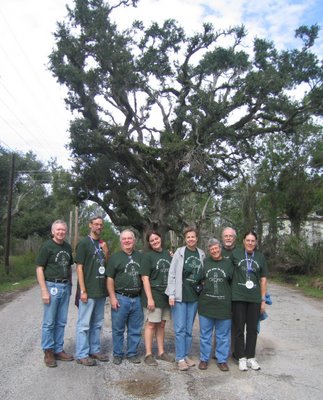 When they gave us directions to get to the Missionary Baptist Church for lunch they said there would be a "tree in the middle of the road." We all assumed this was a tree, maybe a large one, that had fallen in the storm and not yet cleared off the road. It ended up being an old oak that was growing in the middle of the road. People just drove around it. So the team wanted our official photo, complete with matching t-shirts, made in front of the tree. It was kind of a symbol of Mississippi.
I spent my whole day yesterday trying to figure out how to include pictures in with the text but I still forgot an important picture. Here is the guys putting up wallboard onto the ceiling. We were all so proud of this gadget that I know they wouldn't forgive me if I didn't include the picture of it.
 Ron, Beaven and Freddie
But the main thing I want to talk about today is our plastic corrugated tents. When we left in March we all predicted they would be falling apart in six months and we were right. But the reason for the desintegration wasn't what we expected.
I thought the many footsteps on the corrugated material would flatten it out and wear it away to nothingness. But it turned out the culprit was the sun. The ultraviolet rays of the sun dries the plastic, makes it brittle and it cracks at the slightest touch. You could literally turn over in your sleep and poke a hole in the wall with your elbow. In fact, Emily did this once.
It turned out there is a chemical that will protect the plastic from this but when PDA bought these tents they didn't come with the protective coating. The tent manufacturer sent replacement tents free but we still had to go through the effort of taking down the old ones and putting up the new ones. And, after helping with this work for a couple of hours, I can report that it isn't easy to put these suckers up.
Being the analytical folks Presbyterians tend to be, there was much conversation over this choice of housing. It turns out the congressional act that established FEMA in 1988 has certain requirements and people working on the recovery can only have Temporary Housing. That means not even plywood. I looked up the Stafford Act and found it but it has about 5,264 sections and no telling how many pages to it. When I thought of printing it out I remembered we live on a fixed income and I couldn't afford the paper. You would think our nimble congress could amend the act for a disaster that everyone predicts will take at least six years to recover from. But I guess they were all off on tropical vacation with lobbyists when the idea came up.
But it turns out the tents weren't the only thing the sun hates. I found a four inch square of one of the famous FEMA tarps and thought I'd bring it home as a souvenir. But when I looked for it in my bag back home it was only a small and pathetic pile of blue dust. This tells me these tarps are being stretched way beyond their lifespan. I kept seeing wavy ribbons of gauzy-looking stuff around the place. I discovered this is what duct tape looks like after a year in the sun. I gained a new respect for UV rays. Fortunately, Mississippi has a fairly friendly climate (except for hurricanes) and we were actually pretty snug in our humble little plastic tents.
As a matter of fact, because they are built of corrugated plastic you can heat and cool them. While we were there we experienced both heat and cold. I can testify the coolers kept us comfortable at night and when they switched over to heat the night we needed it, we were quite toasty.
Well, yes, the tents did leak like sieves. But the leaks weren't dropping water from the roof onto my head as I slept. The leaks were coming in from the floor and floating our sleeping bags. Aside from the squishy noise this made in the middle of the night I slept very comfortably. And I think Emily and I were the only ones to put our airmattress directly on the floor instead of on top of the cots provided. So we really have no right to complain.
 And here's a picture of the famous Dallas. When we left she was still trying to sweet talk that old guy into letting a team gut his house and repair it. Over a year after the storm.
We took Sunday afternoon to go into New Orleans to "stimulate their economy," a nice way of saying we went out to eat. The town was busier than we saw it in March but still not pre-Katrina business. We did drive by the Ninth Ward and sure enough, the houses do have stuff spray painted on them. I couldn't tell if anyone is living in the houses but we saw people on the street in the neighborhood.
The exciting thing about walking around New Orleans in our bright blue PDA shirts is how many other hurricane relief workers we met. We were stopped seven times on the sidewalk by people who were either in another one of the PDA camps, who were maybe Presbyterians themselves, who were helping with the recovery as part of the Methodists or who just came on their own. As you might imagine, the Presbyterians aren't the only people in the gulf who are helping and we found an exciting comaraderie with like-minded people. It was kind of like what you would get if you combined Six Flags with church camp.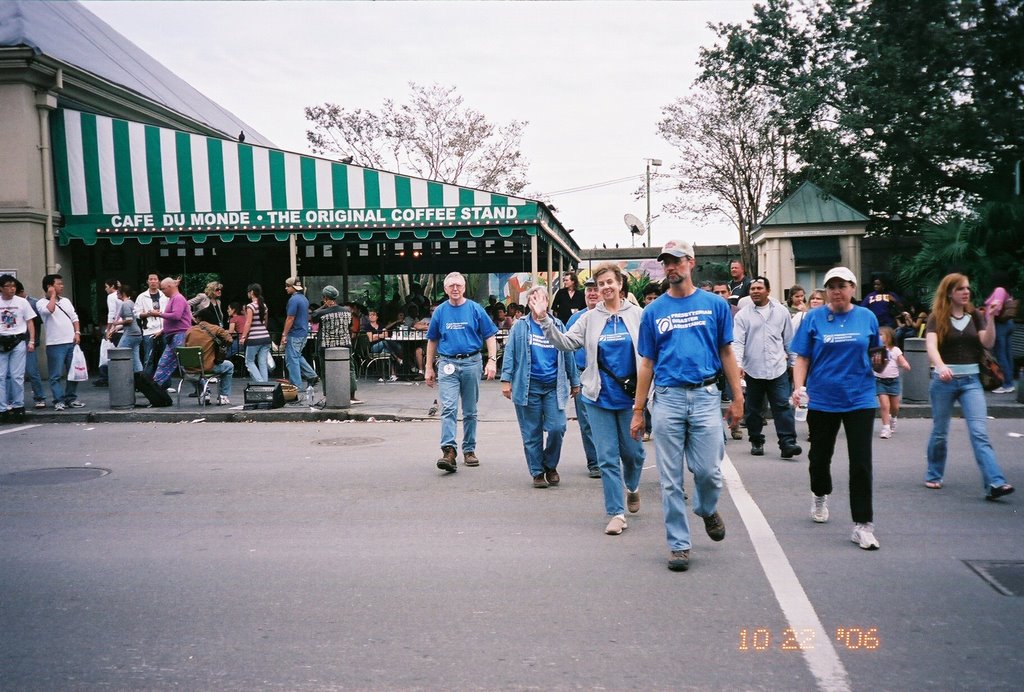 Goodbye New Orleans. I'll see you again in December. Save me a beignet.
Subscribe to:
Posts (Atom)