Once in a while I enjoy a good cigar. I guess I’ve been an occasional closet cigar smoker since my early twenties. My roommate and I would light up one on a particularly dreary Saturday night when our calendars had not presented us with a date. We would spend our empty evening mopeing around and listening to records. We liked the cigars on those evenings because it made our apartment smell like a rich man had been there. Rich men always smell like cigar smoke. At least they did in the 60’s. I love the smell of rich men.
A couple of times I enjoyed a cigar with my daughters. I considered it part of their education as women to learn to smoke a cigar. There is something very powerful in doing something traditionally male. Crossing the gender line safely puts you in forbidden territory and gives you ownership of a foreign land few women ever visit.
Then when I started going to Guatemala each summer I had access to Cuban cigars. Now that’s a trip to forbidden territory in quite a literal way-- it’s been illegal to bring a Cuban cigar into the US since the embargo in the early 60’s. For a few years I would buy one and smoke it there in the country before I came home because I was afraid I’d get arrested for smuggling if I brought it home. Then I got brave the last couple of years and just threw them into my suitcase. My recent trips through customs inspection have been uneventful, not to mention non-existent. I think they’re more worried about people taking hair gel and toothpaste onto planes nowadays than bringing illegal contraband into the country.
I smoked my last one yesterday by the campfire, enjoying the peace and quiet and the great weather. Kind of a celebration of Thanksgiving and autumn weather. I had intended to save it for when Castro dies but I got tired of waiting and I’m not really sure I will feel all that joyful when the old guy does pass on. So I went ahead and dispatched that last one. But I had to admit that I really don’t enjoy smoking cigars as much as I used to. Cigars really are pretty nasty. So, why have I done it all these years? Just because I can.
There’s a lot of meaningless things people do just because we can. And a lot of the things we do “just because we can” are really stupid and dangerous.
Wasn’t that the reason Bill Clinton gave for his risky relationship with Monica Lewinsky? He ended up explaining the whole debacle as something he did “just because I could.”
We’re about to enter the Christmas season. With the Thanksgiving turkey out of the way a lot of people turn to hard core shopping as their holiday hobby. We end up buying a bunch of things people don’t need, or in some cases, don’t even want. Why? Just because we can.
I’m going to a youth Christmas party this Friday. Everybody is supposed to bring a White Elephant gift. I asked for the definition of a white elephant gift and it’s something “less than $10” that is stupid, ugly or unwanted. The game is to pass it around, foisting it off on someone else who doesn’t want it either. Of course, I’m going to go with the flow and not make a big stink about it. But it just seems like a huge waste of money, a lapse of values and another one of those things we do ”just because we can.”
I’m not a person who enjoys shopping for the sport of it. Good thing, too, because we have reached the financial stage where we shouldn’t be buying a bunch of stuff we don’t need. A few Christmases ago, we stopped buying for our girls for Christmas. We found out that for what we were spending on our adult children we could pay for a year’s tuition in a private elementary school in Guatemala. It seemed so appropriate—now that we had put our own kids through school and were finished, why stop? That year we adopted a young boy in Guatemala and paid for his schooling. That was our gift to our kids that year. And every Christmas since they’ve received a new picture of Jorge and an update on his progress. I think he’ll be in the fourth grade this year.
Why do we do it? Just because we can.
About Me

- Jane
- I'm pretty much a typist for the Holy Spirit. I try to put those things into words in a blog called Jane's Journey. I have another blog for recipes called My Life in Food. Also Really Cool Stuff features Labyrinths and other things like how to fry an egg on the sidewalk.(first step: don't do it on the sidewalk, use a skillet) Come along with me as I careen through life.
Wednesday, November 29, 2006


Wednesday, November 22, 2006
Thanksgiving with the "A Pie Apiece" Family
First, here’s a test to see how old you are. Quick, what does the date November 22 bring to mind? If you don’t know immediately, if you have to think about it before you come up with an answer, the chances are that you are less than 50 years old. If you know the answer immediately and can tell me what you were doing when you found out that President Kennedy had been killed, then you are probably closer to my age.
I was in P.E. class but we were sitting in the auditorium because they were decorating the gym for the Homecoming dance. They never had the dance that year. I could bore you with a lot of trivia, more than average because Dallas was my hometown, after all, and I saw a lot of things first hand. But the thing that stands out in my memory that probably says the most about that day is the bus ride home that day. It’s funny the details you remember. You can imagine what a bus full of high school kids usually sounds like, especially on a Friday. But that day in 1963 there was not one word spoken. It was the strangest silence I’ve ever experienced.
OK, now that I’ve outed myself for being old, let’s move on to lighter topics. I’m ready for Thanksgiving. Thanksgiving is one of my favorite holidays because it highlights one of my true talents. I’m a damned good cook. A talent I need like a hole in the head.
I come from people who do Thanksgiving big. Since my birthday is on the 26th, my birthday falls on Thanksgiving Day every seven years or so. I can remember when I was a kid it seemed like we would have the biggest family dinner of the year on my birthday—all the aunts, uncles and cousins along with my grandparents would gather and my mother or one of the aunts would cook a huge turkey dinner with desserts all over the place. It wasn’t until years later I realized this was the family Thanksgiving dinner, not my own personal birthday celebration. I think this may have been a major contributor to my self-esteem all those years to think the meal was all for me. I always knew in my heart that I was worthy of a meal that none of the other cousins got for their birthday.
On Beaven’s side, his great-grandmother worked as a cook when she arrived from Germany and his family owned a wholesale bakery for about 40 years. For special occasions, his Daddy would sometimes wrap a ham in rye bread dough and put it in the revolving commercial oven next to a zillion loaves of bread. The bread would come in and out but the ham stayed for the whole day. This would slow cook the ham while creating a hard crust on the outside that held in all the juices. We could tear off pieces of the rye bread and it would have soaked up ham juices while still maintaining a crusty outer shell. I’m not sure anyone really cared about the ham because the crust was so good.
I’ve been blessed with women in my life who did justice to any meal and taught me their techniques. My stepmother taught me to make dressing by showing me how she and her best friend did it. It was a wonderful sight to watch them joke and taste and bump into each other in the kitchen. They insisted the most important part of dressing was to keep tasting it while they went along. They could take an hour to taste, talk and tinker with the dish, adding a spice here and there. The main ingredient in their dressing, however, was laughter. I think Lois and Martha taught me more about friendship than how to make dressing.
Blanche, my mother-in-law, taught me to make the perfect gravy. Now that I think of it, it was probably her own mother-in-law who taught her. But cooking the Thanksgiving dinner was one time of the year when Blanche just glowed. Wait, that may have been the hot flashes. Never mind.
What have my daughters learned? Not a damned thing. Nobody cooks anymore. Well, not much. I’m not sure how much they have soaked up watching me all these years. At least, not about gravy or dressing. But they do know the most important part of Thanksgiving Day: how to make a decent pecan pie.
The secret is to ignore any instructions about how many pecans you use. Just fill the pie shell with pecans first then add the filling. That way you know you have enough pecans. You can never have too many pecans. You'll have filling left over but which would you rather eat, the pecans or the filling? That’s why they call it PECAN pie. If there’s anything I hate it’s a wimpy pecan pie. I developed this trick myself, thank you, after inheriting my Grandmother Stuart’s basic recipe years ago. She was known in Lancaster, Texas as “the pecan pie lady.” I told you, I come from good stock.
Thanksgiving Day is a day for pies. And when the ETC Family (Els Thomas Carrell) gathers together for Thanksgiving we do pies. First, there’s Grandmother Stuart’s pecan pie, then Beaven wants a pumpkin. Emily insists on her mother-in-law’s cherry pie and Steve always wants some weird pie he grew up eating in Ohio. Some years Elizabeth will request apple pie. One year we counted up after everyone submitted their requests and found we had as many pies as people at the table. Since then we have called Thanksgiving our “A Pie Apiece” meal.
I have to close now and go cook some more. If you would like my recipe for foolproof turkey, go to the blog archives to the November 2005 entry called “Tom.”
Happy Thanksgiving!
I was in P.E. class but we were sitting in the auditorium because they were decorating the gym for the Homecoming dance. They never had the dance that year. I could bore you with a lot of trivia, more than average because Dallas was my hometown, after all, and I saw a lot of things first hand. But the thing that stands out in my memory that probably says the most about that day is the bus ride home that day. It’s funny the details you remember. You can imagine what a bus full of high school kids usually sounds like, especially on a Friday. But that day in 1963 there was not one word spoken. It was the strangest silence I’ve ever experienced.
OK, now that I’ve outed myself for being old, let’s move on to lighter topics. I’m ready for Thanksgiving. Thanksgiving is one of my favorite holidays because it highlights one of my true talents. I’m a damned good cook. A talent I need like a hole in the head.
I come from people who do Thanksgiving big. Since my birthday is on the 26th, my birthday falls on Thanksgiving Day every seven years or so. I can remember when I was a kid it seemed like we would have the biggest family dinner of the year on my birthday—all the aunts, uncles and cousins along with my grandparents would gather and my mother or one of the aunts would cook a huge turkey dinner with desserts all over the place. It wasn’t until years later I realized this was the family Thanksgiving dinner, not my own personal birthday celebration. I think this may have been a major contributor to my self-esteem all those years to think the meal was all for me. I always knew in my heart that I was worthy of a meal that none of the other cousins got for their birthday.
On Beaven’s side, his great-grandmother worked as a cook when she arrived from Germany and his family owned a wholesale bakery for about 40 years. For special occasions, his Daddy would sometimes wrap a ham in rye bread dough and put it in the revolving commercial oven next to a zillion loaves of bread. The bread would come in and out but the ham stayed for the whole day. This would slow cook the ham while creating a hard crust on the outside that held in all the juices. We could tear off pieces of the rye bread and it would have soaked up ham juices while still maintaining a crusty outer shell. I’m not sure anyone really cared about the ham because the crust was so good.
I’ve been blessed with women in my life who did justice to any meal and taught me their techniques. My stepmother taught me to make dressing by showing me how she and her best friend did it. It was a wonderful sight to watch them joke and taste and bump into each other in the kitchen. They insisted the most important part of dressing was to keep tasting it while they went along. They could take an hour to taste, talk and tinker with the dish, adding a spice here and there. The main ingredient in their dressing, however, was laughter. I think Lois and Martha taught me more about friendship than how to make dressing.
Blanche, my mother-in-law, taught me to make the perfect gravy. Now that I think of it, it was probably her own mother-in-law who taught her. But cooking the Thanksgiving dinner was one time of the year when Blanche just glowed. Wait, that may have been the hot flashes. Never mind.
What have my daughters learned? Not a damned thing. Nobody cooks anymore. Well, not much. I’m not sure how much they have soaked up watching me all these years. At least, not about gravy or dressing. But they do know the most important part of Thanksgiving Day: how to make a decent pecan pie.
The secret is to ignore any instructions about how many pecans you use. Just fill the pie shell with pecans first then add the filling. That way you know you have enough pecans. You can never have too many pecans. You'll have filling left over but which would you rather eat, the pecans or the filling? That’s why they call it PECAN pie. If there’s anything I hate it’s a wimpy pecan pie. I developed this trick myself, thank you, after inheriting my Grandmother Stuart’s basic recipe years ago. She was known in Lancaster, Texas as “the pecan pie lady.” I told you, I come from good stock.
Thanksgiving Day is a day for pies. And when the ETC Family (Els Thomas Carrell) gathers together for Thanksgiving we do pies. First, there’s Grandmother Stuart’s pecan pie, then Beaven wants a pumpkin. Emily insists on her mother-in-law’s cherry pie and Steve always wants some weird pie he grew up eating in Ohio. Some years Elizabeth will request apple pie. One year we counted up after everyone submitted their requests and found we had as many pies as people at the table. Since then we have called Thanksgiving our “A Pie Apiece” meal.
I have to close now and go cook some more. If you would like my recipe for foolproof turkey, go to the blog archives to the November 2005 entry called “Tom.”
Happy Thanksgiving!
Wednesday, November 15, 2006
Campfires and Computers

We had just about the most perfect Saturday ever. Of course, it involved our grandkids. Isn't that what heaven will look like--siting around with your grandchildren and doing something you both enjoy? In this case, the two things I enjoy most in the world are my granddaughters and sitting by a campfire. I got to do both Saturday.
Texas autumns last about 25 days so we have to enjoy each day we get. It always seems to me like we go directly from suffocating heat to ice storms. But last Saturday the air went from cool to warm and you couldn't complain about either. The sky was clear and there was just a hint of breeze. It was a perfect day to be outdoors.
Emily was off on a mini-vacation to New York City with her sister so we kept the girls and Steve joined us late Friday night after work. We had the whole day Saturday to do whatever we want. Steve may secretly wish he had married into a family of football people but he never lets on if he does. With his only other TV choice being a Sponge Bob Squarepants marathon he preferred to help Beaven clear brush.
We have a spot where our pond overflows into the woods and the creek. It provides a lot of vines and brush to clear. They put on their gloves and grabbed a chainsaw and commenced to do all that macho scratching and spitting stuff men do. Meanwhile, the girls and I fed the brush into a fire.
I found a vine hanging from a tree that was perfect for swinging. Once the girls had the hang of it (unintentional pun) they spent the rest of the day swinging on the vine. Sarah perfected her technique and eventually could pick the spot she landed.

Here she is looking over her shoulder to choose her spot. Eventually the men and the fire both slowed down enough for lunch. For lunch we had hot dogs and S'mores. Later, for dinner we had more hot dogs and some kind of apple thing you cook in the coals. Steve remembered the recipe from his Cub Scout days. Nobody worried about getting the table messy. Well, nobody around here ever worrries about that except me. But it made for a much more relaxing meal without Granny freaking out.
We stayed outside by the fire until dark. That's the best time of all for a campfire. The tiredness of your muscles allows your thoughts to take over in a relaxed way and wander around aimlessly. You can have some of the best conversations of your life sitting around an evening campfire. The fire dies down to coals. The wind will periodically blow through the coals until the colors dance from bright orange to quiet red. There is nothing better than to watch the coals dance. I like to think when I get to heaven that's how I will spend eternity.
When we finally went into the house for baths and bed someone brought up the subject of Sharks. Sarah must have been studying them in school. She went to the computer and was telling Beaven all about them then said the words that stopped me in my tracks. With great confidence that comes from being in the second grade, she said: "If you can get me into Google I can show you."
The next thing I knew she was blithly surfing the internet at our computer. My first thought was what a smart grandkid I have who can already use a computer better than some adults. But my thoughts soon turned to horror. What would my seven year old granddaughter find on the information superhighway after typing in the work "shark?" Loan sharks? Los Angeles gangs? "Shark" is one of those words that can be used for many dangerous-sounding organizations. But we had opened Pandora's Box and there was no getting the lid back on.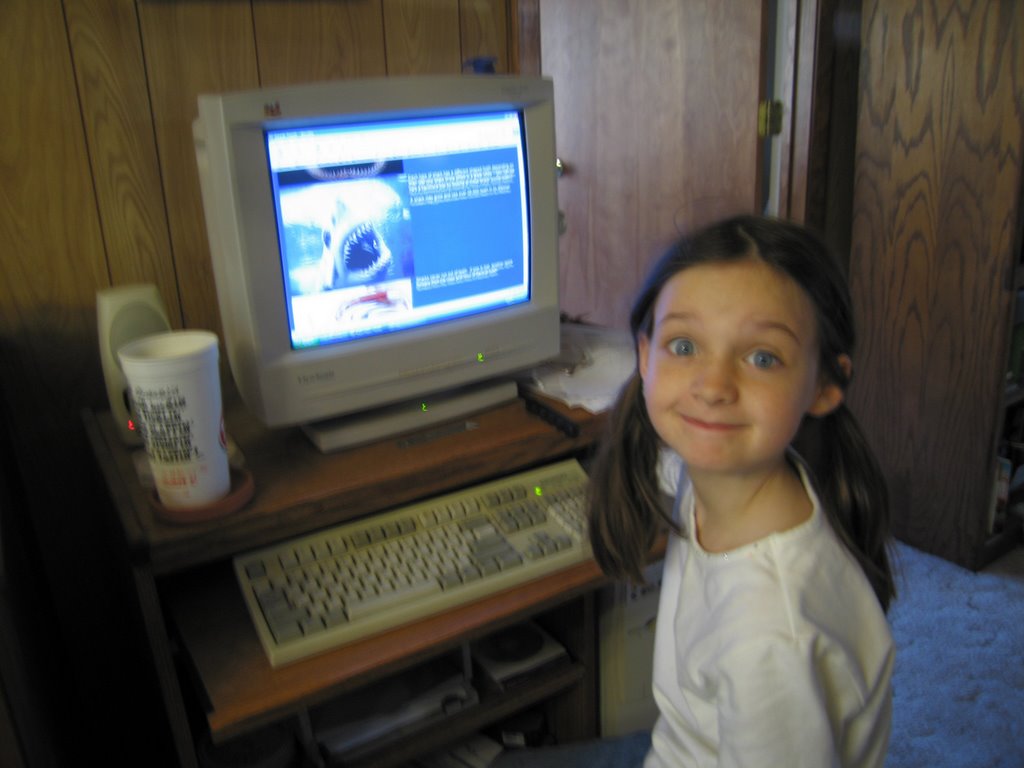
Sarah is now an electronic neighbor to the entire world. She has access to information leading to the cure for cancer as well as the instructions to build a bomb. She's open to information her grandparents never dreamed and she's vulnerable to the lowest level of humankind.
I am left with more than questions about sharks. How do we protect her? Do we isolate her or help her make safe choices about what she sees? What do we teach her about how to relate to the world around her? This is such a basic question that it could relate to international politics if you have enough wood for the campfire.
Beaven and I are going to Longview in a couple of hours to celebrate our anniversary. Maybe we'll find some hilarious adventure. See you next Wednesday.
Wednesday, November 08, 2006
Miscellaneous Oddities of Disaster Recovery
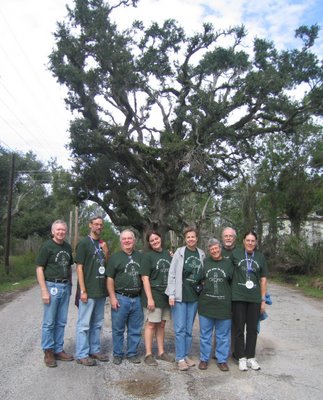 When they gave us directions to get to the Missionary Baptist Church for lunch they said there would be a "tree in the middle of the road." We all assumed this was a tree, maybe a large one, that had fallen in the storm and not yet cleared off the road. It ended up being an old oak that was growing in the middle of the road. People just drove around it. So the team wanted our official photo, complete with matching t-shirts, made in front of the tree. It was kind of a symbol of Mississippi.
I spent my whole day yesterday trying to figure out how to include pictures in with the text but I still forgot an important picture. Here is the guys putting up wallboard onto the ceiling. We were all so proud of this gadget that I know they wouldn't forgive me if I didn't include the picture of it.
 Ron, Beaven and Freddie
But the main thing I want to talk about today is our plastic corrugated tents. When we left in March we all predicted they would be falling apart in six months and we were right. But the reason for the desintegration wasn't what we expected.
I thought the many footsteps on the corrugated material would flatten it out and wear it away to nothingness. But it turned out the culprit was the sun. The ultraviolet rays of the sun dries the plastic, makes it brittle and it cracks at the slightest touch. You could literally turn over in your sleep and poke a hole in the wall with your elbow. In fact, Emily did this once.
It turned out there is a chemical that will protect the plastic from this but when PDA bought these tents they didn't come with the protective coating. The tent manufacturer sent replacement tents free but we still had to go through the effort of taking down the old ones and putting up the new ones. And, after helping with this work for a couple of hours, I can report that it isn't easy to put these suckers up.
Being the analytical folks Presbyterians tend to be, there was much conversation over this choice of housing. It turns out the congressional act that established FEMA in 1988 has certain requirements and people working on the recovery can only have Temporary Housing. That means not even plywood. I looked up the Stafford Act and found it but it has about 5,264 sections and no telling how many pages to it. When I thought of printing it out I remembered we live on a fixed income and I couldn't afford the paper. You would think our nimble congress could amend the act for a disaster that everyone predicts will take at least six years to recover from. But I guess they were all off on tropical vacation with lobbyists when the idea came up.
But it turns out the tents weren't the only thing the sun hates. I found a four inch square of one of the famous FEMA tarps and thought I'd bring it home as a souvenir. But when I looked for it in my bag back home it was only a small and pathetic pile of blue dust. This tells me these tarps are being stretched way beyond their lifespan. I kept seeing wavy ribbons of gauzy-looking stuff around the place. I discovered this is what duct tape looks like after a year in the sun. I gained a new respect for UV rays. Fortunately, Mississippi has a fairly friendly climate (except for hurricanes) and we were actually pretty snug in our humble little plastic tents.
As a matter of fact, because they are built of corrugated plastic you can heat and cool them. While we were there we experienced both heat and cold. I can testify the coolers kept us comfortable at night and when they switched over to heat the night we needed it, we were quite toasty.
Well, yes, the tents did leak like sieves. But the leaks weren't dropping water from the roof onto my head as I slept. The leaks were coming in from the floor and floating our sleeping bags. Aside from the squishy noise this made in the middle of the night I slept very comfortably. And I think Emily and I were the only ones to put our airmattress directly on the floor instead of on top of the cots provided. So we really have no right to complain.
 And here's a picture of the famous Dallas. When we left she was still trying to sweet talk that old guy into letting a team gut his house and repair it. Over a year after the storm.
We took Sunday afternoon to go into New Orleans to "stimulate their economy," a nice way of saying we went out to eat. The town was busier than we saw it in March but still not pre-Katrina business. We did drive by the Ninth Ward and sure enough, the houses do have stuff spray painted on them. I couldn't tell if anyone is living in the houses but we saw people on the street in the neighborhood.
The exciting thing about walking around New Orleans in our bright blue PDA shirts is how many other hurricane relief workers we met. We were stopped seven times on the sidewalk by people who were either in another one of the PDA camps, who were maybe Presbyterians themselves, who were helping with the recovery as part of the Methodists or who just came on their own. As you might imagine, the Presbyterians aren't the only people in the gulf who are helping and we found an exciting comaraderie with like-minded people. It was kind of like what you would get if you combined Six Flags with church camp.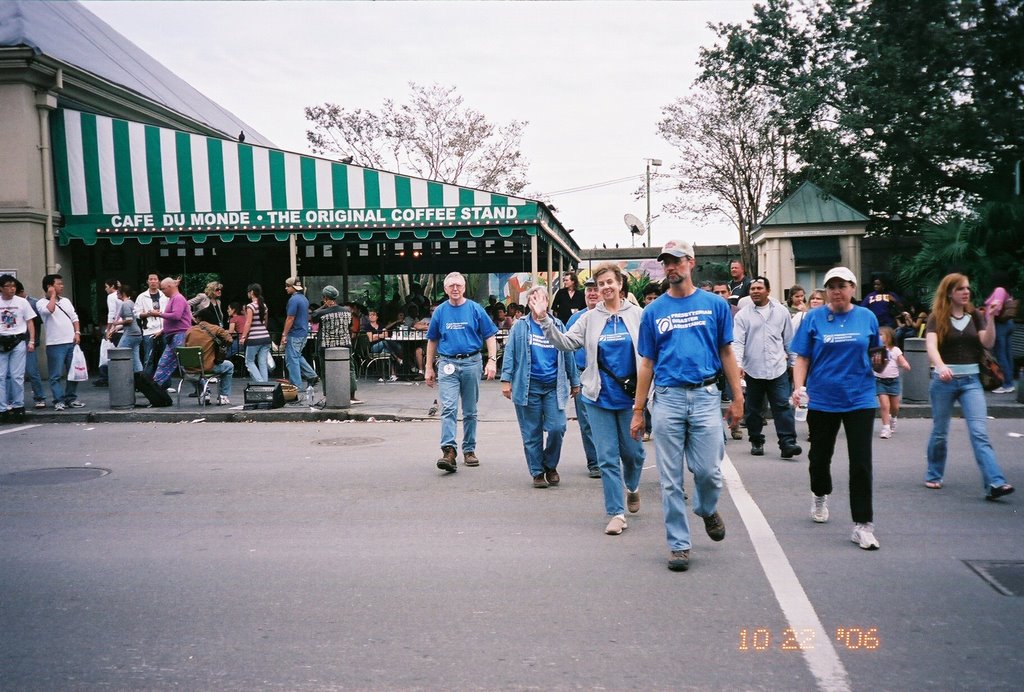 Goodbye New Orleans. I'll see you again in December. Save me a beignet.
Tuesday, November 07, 2006
Out of Chaos, Hope
 More about our week with the hurricane disaster recovery:
The work assignments were a little chaotic, themselves bearing witness to the PDA motto. There are many teams of people in the gulfcoast area offering help with a wide assortment of skills. There’s no strict requirements for the work-- you don’t have to be a licensed plumber or electrician to do the work, so that frees things up a bit. But sometimes PDA scheduled work for us only to arrive at the house to find the work had been done by someone else that PDA didn’t even know about and we weren’t needed. It only stands to reason that people will take any help they can get whenever it’s offered and to hell with anyone’s “schedule.”
Dallas spent the week trying to sweet talk some guy into letting us inside his house to gut it so he could begin the re-building process. He still wasn’t ready and had been living in one room without electricity or water for over a year now. She called him every day and would report to us that he was almost ready but not quite.
The town of Pearlington was easy to work in because it’s a small town and everybody knows each other. There’s only about 1,600 people there and maybe only 2 or 3 neighborhoods. It doesn’t take long to get to a job site. It was called “the town that American forgot” because they went six weeks before any volunteers showed up. With a mixture of blacks and whites I never detected an attitude of racial discord even after somebody said it was an old center for the KKK. The hurricane certainly didn’t make any distinctions. When a young white man died the week we were there the black church took up a collection for his funeral.
Our first day we went to Johnnie and Evelyn’s house. Their house was washed about a couple of blocks away and they got a new one from Walls of Hope. These are kit houses. The lumber is cut and organized in Iowa. They can fit three houses onto one 18 wheeler and ship it to Mississippi. Check out their website: http://www.wallsofhope.net/.
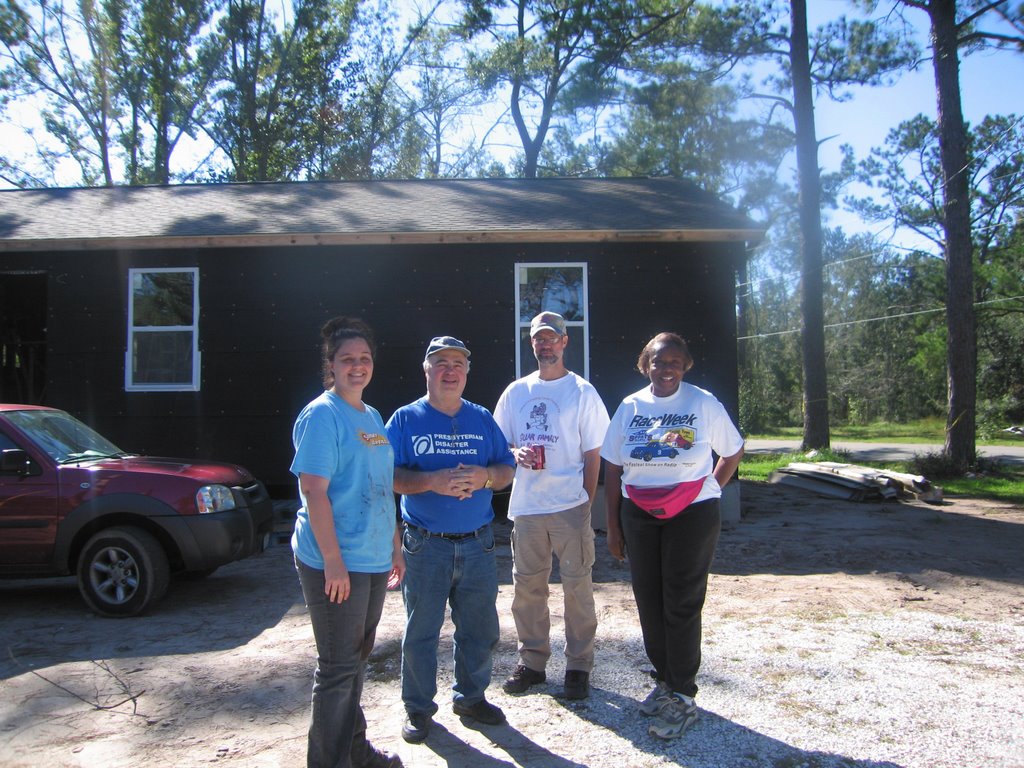
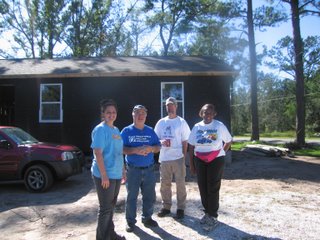 Here's a picture of Emily, Beaven and Clay with Shirley Thompson in front of her Walls of Hope house.This is what the Walls of Hope houses look like after the whole kit has been built. Shirley
must provide the siding and the interior work.
The Walls of Hope kits will provide walls and a roof with shingles. It’s constructed by volunteers so the only thing you pay for is the lumber. Johnnie and Evelyn got one of the biggest houses but they are housing eight people. We never were clear how everybody in their family is related to each other but we also ran into a lot of families arranged this way. Johnnie and Evelyn are putting up their own siding and will arrange for the plumbing and electricity. Our team was sent to build a wrap-around deck. It took the men a while to measure and commence digging the holes for the posts so the rest of us watched a mother and son couple from Canada putting up siding.
I loved their story. Ilene is a retired principal and her son, Alex, looks around college age. We knew they were mother and son well before we introduced ourselves because she was telling him what to do all the time and he obviously didn’t agree with her. This was their third trip to the coast. They weren’t part of any organized group. They just got on a plane and came. They contacted a guy in the area people call “Canada John” and he arranged for them to stay in a FEMA trailer. They just got on a plane and came. When we got there they were about half-way finished with the siding and a couple of our gals climbed up on the scaffolding to help

Emily and Ila siding Johnnie and Evelyn’s house.
One of the great things about this work is that most of it is really easy once you start doing it. It’s just that most people never have an opportunity to put up a few sheets of siding without having to order it, pay for it, wait for it to be delivered, put up the scaffolding and live with the consequences of what happens if you do it wrong. Siding was like that. A huge job if it’s your own house, it becomes just a matter of a couple of nails here and there when all the ground work has been done for you. After a while Dallas came by and told us Shirley Thompson needed people to unload sheetrock that was being delivered. Since the siding was really the Canadians’ project we went to help unload the sheetrock.
We had already met Shirley’s mother, Annie Oliver, a precious little 87 year old lady. Small and soft-spoken, Miss Annie didn’t say much or move much but you could tell she was one of the neighborhood’s most beloved ladies. She and Shirley both had Walls of Hope houses. Shirley told us her mom chose a floor plan that had a hall down the middle of the house because she
had never had a hall before.
Unloading sheetrock is one of the most underappreciated jobs in the world. Sheetrock is heavy. And bulky. To top it off, these sheets were the twelve-foot sections, not the wimpy eight foot kind. We eventually developed a technique where two people would stand at the stack in the front yard where the delivery truck had left it, pull a sheet toward them, pivot it down and slide it off the stack then lift it and carry it over to the front door. At the door, another team of three people would receive the sheet and haul it up to the doorway where another person joined the effort and all four carried it inside and onto the indoors stack. We huffed and puffed our way through this job and, by taking numerous breaks so our muscles wouldn’t go on strike, we eventually got 140 sheets of the stuff inside.
On our second day of work we started putting up the sheetrock. Half of our team, mostly the women, did the walls, starting with the section at the floor. The men of our team worked on the ceiling using a special piece of equipment that balanced a whole section and held it while they could crank it up against the ceiling. The men loved this gadget and spent a lot of time balancing and cranking. The women worked faster than the men in spite of the men having special quipment. Again, sheetrocking is much easier than you think once you try it.
We heard through the grapevine that Johnnie’s 24 yr old nephew had died, apparently of a heart attack. When we went to lunch at the Missionary Baptist church that day they announced the death and took up a collection “so we can get this boy buried,” because the family didn’t have any money for the funeral. I got the impression this happens here a lot and money
started showing up in the basket they had put out.
started showing up in the basket they had put out.
On our third day of work PDA had a new team at camp who claimed to be very experienced at sheetrock (translation: they can put up more than one sheet on the ceiling in a day.) So, after a few phone calls around town, we were sent out to paint Michael and Susan Hanley’s house. This was the house where the ocean traded them crabs for catfish. Their house is brick and was
still standing after the storm but the interior was under water and had been gutted. With all of us working together, we made quick work of it and even invented a new technique for staining 12ft sections of trim wood. We could do the job in three seconds per section. Ila and I were quite taken with our skills but no one else seemed as impressed.
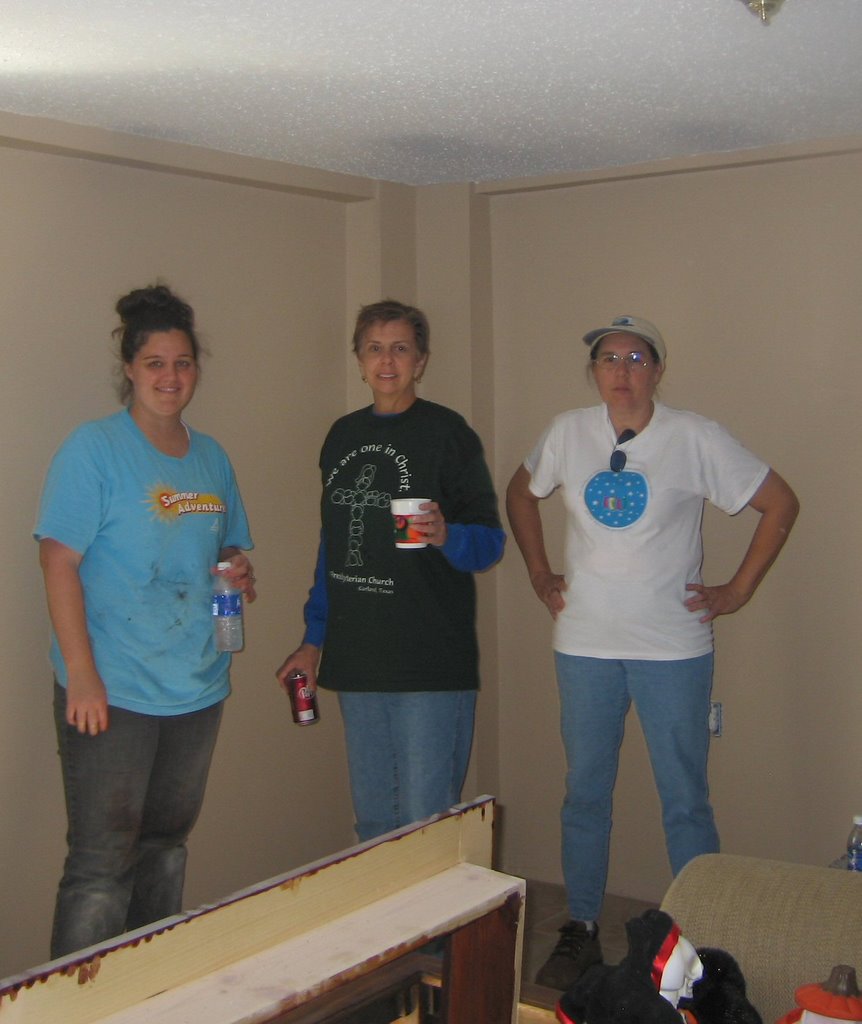
Emily, Ila and Chris finish painting the Hanley's house
None of the stuff we did was very hard. We enjoyed working with each other. It was very empowering to most of us who had never done some of these things before. Eight people and three days of work. We were only a small part of the recovery but we did a lot more than meets the eye. Monday night new teams arrived and one group in particular impressed me: SWOOP. Their website is http://www.swoop4u.org/. It stands for Strong Women Organizing Outrageous Projects. In North Carolina where they live they will swoop in and do a day’s work of mostly construction for women in need. They found out PDA had housing facilities and came to Pearlington. When devotion time was announced they looked kind of startled at this new idea of a devotional being part of their work. Someone looked around sheepishly asking “Do we have anybody in the group who is religious?” But when Miss Annie sat in her chair and belted out “Precious Lord” they were overcome by tears.
Precious Lord, take my hand
Lead me on, help me stand
I am tired, I am weak, I am worn.
Through the storm, through the night
Lead me on to the light
Take my hand, precious Lord
Lead me home.
Shirley Thompson summed it up: She told us she had prayed for people justLead me on, help me stand
I am tired, I am weak, I am worn.
Through the storm, through the night
Lead me on to the light
Take my hand, precious Lord
Lead me home.
like the PDA to come. “Lord, send us help. You know we can’t do this by
ourselves. Send us some help. They will know how to help. They will know
how we’re feeling.” She never had any doubts we would come.


Subscribe to:
Posts (Atom)